Physical Address
304 North Cardinal St.
Dorchester Center, MA 02124
Physical Address
304 North Cardinal St.
Dorchester Center, MA 02124
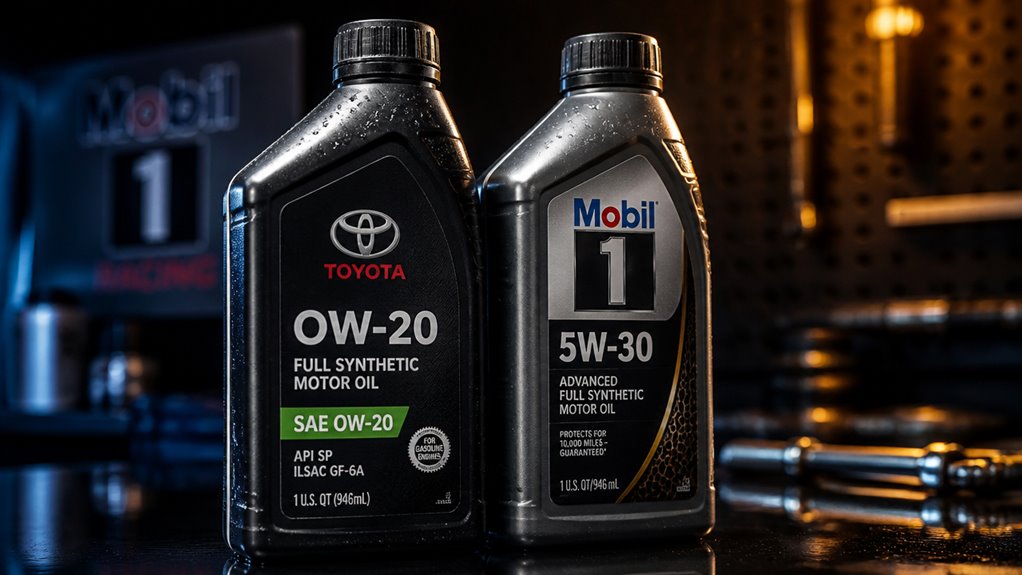
You’ll find 0W-20 offers superior cold-start flow and better fuel economy by reducing internal friction. This makes it ideal for colder climates and daily driving.
In contrast, 5W-30 delivers a thicker lubrication film under high heat and heavy loads. This protects engines built for more demanding conditions like towing or turbocharging.
Always follow your manufacturer’s oil specification to guarantee peak performance and engine longevity.
Keep exploring to understand which oil suits your engine’s specific needs best.
| Comparison Factors | 0W-20 Engine Oil | 5W-30 Engine Oil |
|---|---|---|
| SAE Viscosity Grade | 0W-20 | 5W-30 |
| Winter Viscosity Classification | 0W — lower-temperature operating capability | 5W — higher minimum test temperatures than 0W |
| Operating Temperature Viscosity | SAE 20 — thinner at normal operating temperature | SAE 30 — thicker at normal operating temperature |
| Cold-Start Performance | Better low-temperature pumpability classification | Good cold-start performance within its specified temperature range |
| Oil Circulation | Lower flow resistance in many conditions | Higher viscosity creates more resistance under comparable conditions |
| Lubrication Film Thickness | Generally thinner oil film at operating temperature | Generally thicker oil film at operating temperature |
| Fuel Efficiency | May improve fuel economy in engines designed for it | May produce slightly higher viscous losses |
| High-Temperature Performance | Suitable for engines engineered for lower-viscosity oil | Suitable for engines requiring higher operating viscosity |
| Heavy-Load Conditions | Appropriate when approved for the engine and load | Often specified for engines requiring thicker lubrication films |
| Engine Wear Protection | Effective when matching manufacturer specifications | Effective when matching manufacturer specifications |
| Turbocharged Engines | Used in compatible turbocharged engine designs | Used in compatible turbocharged engine designs |
| Common Applications | Modern engines designed for low-viscosity lubrication | Engines designed for SAE 30 operating viscosity |
| Synthetic Oil Availability | Widely available in synthetic formulations | Widely available in synthetic formulations |
| Oil Change Frequency | Depends on vehicle maintenance schedule and oil specification | Depends on vehicle maintenance schedule and oil specification |
| Switching Between Grades | Use only when permitted by the manufacturer | Use only when permitted by the manufacturer |
| Overall Recommendation | Choose when 0W-20 is specified or approved | Choose when 5W-30 is specified or approved |

When you see oil grades like 0W-20 and 5W-30, the numbers tell you about the oil’s flow characteristics at different temperatures.
Oil grades like 0W-20 and 5W-30 indicate how oil flows in cold and hot temperatures.
The first number with a “W” indicates winter pumpability. 0W means the oil flows more easily at cold temperatures than 5W, ensuring better low-temperature circulation.
The “W” doesn’t imply zero viscosity; it signifies improved cold-start performance compared to higher “W” grades.
The second number reflects the oil’s viscosity at operating temperature. 20-weight oil is thinner when hot than 30-weight oil.
This means 5W-30 maintains a thicker lubrication film under heat than 0W-20.
Choosing the right oil viscosity is important because it balances cold start flow and hot operating protection to optimize engine performance and longevity.
How does cold weather impact the performance of 0W-20 compared to 5W-30 oil?
You’ll find that 0W-20 exhibits superior low-temperature flow characteristics, thanks to its lower winter grade (0W vs. 5W).
This means 0W-20 pumps more readily during engine startup in cold conditions, reducing viscous drag and ensuring quicker lubrication of moving parts.
Conversely, 5W-30 has higher cold-start viscosity, resulting in slower initial circulation and increased resistance on startup.
If you operate in harsh winter environments, 0W-20’s improved pumpability can minimize wear during critical cold starts.
However, both oils remain within manufacturer specifications for many applications.
You should always consult your owner’s manual, but if rapid cold flow and early lubrication matter most to you, 0W-20 generally outperforms 5W-30 in cold weather.
The lower cold-viscosity rating of 0W-20 allows for faster oil circulation on startup, reducing startup wear in extreme cold.
Although both 0W-20 and 5W-30 oils operate effectively at engine temperatures, 5W-30 maintains a thicker viscosity film under heat. This provides enhanced protection in high-load or high-temperature conditions.
You’ll find that 5W-30’s higher hot viscosity reduces metal-to-metal contact by sustaining a robust lubricating film. This is critical in engines subjected to greater stress or elevated temperatures.
Conversely, 0W-20’s thinner hot viscosity promotes easier circulation and reduced internal friction. This benefits fuel efficiency but offers less film thickness under extreme heat.
When evaluating hot engine performance, consider how your engine’s bearing clearances and thermal load align with these viscosity characteristics.
Using 0W-20 in an engine designed for 5W-30 might compromise protection during sustained high-temperature operation. Meanwhile, 5W-30 can provide a broader margin for thermal stress.
However, deviating from the manufacturer’s recommended oil viscosity can lead to increased engine wear and potential coverage issues.
You really need to pay attention to manufacturer oil specifications. They’re crucial for ensuring your engine runs at its best and lasts a long time. These specs are all about the right viscosity and the additives that are specifically designed for your engine’s unique setup and how it operates.
If you ignore these recommendations, you could run into compatibility problems. That can lead to increased wear on your engine or even a drop in efficiency. So, sticking to the manufacturer’s guidelines is definitely the way to go! Choosing oils that meet Toyota’s specific viscosity grade standards helps maintain optimal engine protection and performance.
Because engine manufacturers rigorously test and specify oil grades for their vehicles, following their recommendations guarantees peak engine protection and performance. Ignoring these specs risks improper lubrication, increased wear, and reduced engine protection.
When you prioritize manufacturer oil specs, you secure compatibility with engine design, operating conditions, and emissions controls.
| Benefit | Risk Ignored | Outcome |
|---|---|---|
| Optimal wear protection | Increased friction | Reduced engine lifespan |
| Compliance with requirements | Voided protection | Increased repair costs |
| Emissions system safety | Catalyst damage | Failed emissions tests |
Trusting your manufacturer’s oil grade specification isn’t just about compliance. It’s about preserving engine integrity and maximizing performance under all operating conditions. Choosing the correct oil viscosity based on cold start flowability is especially important to reduce engine wear and ensure efficient lubrication during startup.
When selecting motor oil, matching the manufacturer’s specifications guarantees the lubricant meets the engine’s design tolerances, materials, and performance requirements.
You must use oils that comply with the required viscosity grade and API or ACEA standards to secure proper lubrication film thickness, wear protection, and thermal stability.
Deviating from specs risks insufficient oil flow in cold starts or inadequate viscosity at operating temperatures. This can potentially cause accelerated wear or engine damage.
For example, using 0W-20 when 5W-30 is specified can reduce film strength under high load. Conversely, using 5W-30 when 0W-20 is specified can increase drag and reduce fuel efficiency.
Manufacturers engineer engines with precise bearing clearances and emission controls that depend on the recommended oil properties.
Adhering strictly to these specs maintains reliability, performance, and service coverage.
Choosing the correct oil viscosity also depends on factors such as engine age, design, and typical operating conditions, ensuring optimal cold-start protection and wear resistance.
You might notice that 0W-20 usually provides better fuel efficiency compared to 5W-30. Why’s that? Well, it has a lower viscosity when the engine is running, which means less pumping resistance. This thinner oil helps cut down on internal engine friction, making everything run more smoothly and, in turn, using less fuel.
Of course, the actual fuel economy gains can vary. It really depends on your engine’s design and what the manufacturer recommends. So, while 0W-20 might be the better choice for some, it’s always good to check what works best for your vehicle! Many modern 0W-20 oils also include additive technology that reduces deposits and improves wear protection, enhancing overall engine performance.
Typically, choosing 0W-20 over 5W-30 can enhance fuel efficiency by reducing internal engine friction and pumping losses. The lower viscosity of 0W-20 at operating temperature means your engine oil circulates more freely, improving mechanical efficiency.
Meanwhile, 5W-30, with its higher hot viscosity, increases resistance slightly, which can marginally reduce fuel economy.
| Parameter | 0W-20 | 5W-30 |
|---|---|---|
| Operating Viscosity | Lower (thinner at temp.) | Higher (thicker at temp.) |
| Cold-Start Flow | Faster pumpability | Slower pumpability |
| Fuel Economy Impact | Improved (less drag) | Slightly reduced (more drag) |
Selecting 0W-20 helps optimize fuel economy, especially in modern engines designed for thinner oils. Many top synthetic oils meeting ILSAC GF-6 standards ensure reduced sludge and deposits, further supporting engine efficiency.
Regarding pumping losses, choosing 0W-20 over 5W-30 reduces the energy your engine expends to circulate oil.
Because 0W-20 has a lower viscosity at operating temperature, it flows more easily through engine channels and bearing clearances. This decreases the resistance your oil pump must overcome.
This lower internal friction directly translates to reduced parasitic drag on the crankshaft, improving mechanical efficiency.
In contrast, 5W-30’s higher hot viscosity creates greater pumping losses, marginally increasing fuel consumption, especially under steady-state conditions.
While the difference may seem subtle, engines optimized for lighter oil grades can leverage 0W-20 to enhance fuel economy by minimizing energy lost to oil circulation.
Ultimately, selecting 0W-20 aligns with efficiency goals where manufacturer specifications permit, balancing adequate lubrication with reduced mechanical drag.
Additionally, 0W-20’s ability to provide faster oil circulation during cold starts further reduces engine wear and contributes to overall efficiency.
Which engines benefit most from 0W-20 versus 5W-30 depends largely on their design parameters and operating demands.
You’ll find 0W-20 suits modern gasoline engines engineered for fuel efficiency. These engines have tighter bearing clearances that demand lower viscosity to reduce internal friction and pumping losses.
It’s ideal for vehicles emphasizing cold-start performance and lighter oil films.
Conversely, 5W-30 fits engines requiring a thicker oil film at operating temperature, such as turbocharged or higher-load gasoline and diesel engines.
Its higher hot viscosity offers enhanced protection under sustained thermal stress and mechanical load.
When selecting between these grades, consider manufacturer specifications, engine design tolerances, and intended operating conditions.
This ensures peak lubrication and longevity without compromising efficiency or protection.
Additionally, oils meeting ILSAC GF-6A and API SP standards provide modern engine compatibility and optimized performance.
Engines operating under higher thermal and mechanical stress demand oil that maintains a robust protective film at elevated temperatures.
You should opt for 5W-30 over 0W-20 when your engine faces conditions requiring thicker lubrication to prevent wear and maintain peak performance.
Consider these factors:
Selecting 5W-30 in these scenarios helps preserve engine longevity and efficiency under strenuous conditions where 0W-20’s thinner film might be insufficient.
Although switching between 0W-20 and 5W-30 is sometimes necessary, you should always verify your vehicle manufacturer’s recommendations before making the change.
Begin by assessing your climate and engine load conditions. 0W-20 suits colder temperatures and lighter loads, while 5W-30 performs better under higher heat and stress.
When switching, fully drain the existing oil to minimize viscosity contamination. Use a high-quality oil filter compatible with the new grade.
Monitor engine performance and oil pressure after the switch to detect any anomalies. Avoid frequent switching, as it may disrupt oil film stability.
Lastly, make sure the replacement oil meets or exceeds the original specification to maintain engine protection, fuel efficiency, and emission compliance.
Adhering to these steps optimizes engine longevity and performance when alternating between these viscosity grades.
Yes, using 0W-20 or 5W-30 against your vehicle manufacturer’s recommendations can void your warranty.
Manufacturers specify oil grades to match engine design, load, and emissions controls.
If you choose an unapproved viscosity, you risk warranty denial for engine damage claims.
Always consult your owner’s manual and use the recommended oil grade and specification to guarantee compliance with warranty terms and peak engine protection.
You know what they say: “An ounce of prevention is worth a pound of cure.”
Typically, you should change your oil every 5,000 to 7,500 miles, regardless of whether you use 0W-20 or 5W-30.
However, always follow your vehicle manufacturer’s recommendations precisely.
Factors like driving conditions, engine design, and oil quality impact the interval more than viscosity grade alone.
Stick to the specified schedule to guarantee peak engine protection and performance.
Synthetic 0W-20 and 5W-30 oils differ mainly in viscosity, not base formulation.
Both offer superior thermal stability, oxidation resistance, and flow compared to conventional oils.
You’ll notice synthetic 0W-20 flows better at cold start and reduces friction at operating temperature, aiding fuel economy.
Synthetic 5W-30 provides a thicker oil film under heat and load, enhancing protection.
Choose based on your engine’s viscosity requirements and operating conditions rather than synthetic versus conventional alone.
Mixing 0W-20 and 5W-30 oils won’t immediately harm your engine, but it’s not ideal.
The combined viscosity may alter flow characteristics, potentially reducing cold-start efficiency and altering hot-film protection.
Over time, inconsistent oil properties might affect wear protection and fuel economy.
You should stick to the manufacturer’s recommended grade to guarantee peak lubrication, thermal stability, and engine longevity.
Avoid mixing unless it’s a temporary measure before a full oil change.
Additives in 0W-20 and 5W-30 oils can differ more than you’d expect, like night and day in their chemistry.
You’ll find variations in detergent levels, anti-wear agents, and viscosity modifiers tailored to each grade’s performance needs.
While both prioritize engine protection, 0W-20 formulations often emphasize fuel economy and cold-start flow.
In contrast, 5W-30 additives focus on maintaining thicker film strength under higher heat and load conditions.
Choosing between 0W-20 and 5W-30 hinges on your vehicle’s demands and driving conditions.
While 0W-20 offers smoother starts and superior savings in fuel, 5W-30 shines under sizzling stress and heavier loads.
Stick strictly to your manufacturer’s specs to safeguard your engine’s health.
Switching wisely guarantees seamless shifts in viscosity without sacrificing performance.
Prioritize precision, performance, and protection to power your ride perfectly, no matter the weather or workload.