Physical Address
304 North Cardinal St.
Dorchester Center, MA 02124
Physical Address
304 North Cardinal St.
Dorchester Center, MA 02124

You’ll want lithium grease for general-purpose use, moderate loads, and higher-speed applications. Its stable lithium soap thickener and water resistance make it ideal for these conditions.
Moly grease is thickened with lithium complex and contains solid molybdenum disulfide particles. It excels under heavy shock, slow-speed oscillation, and extreme pressure by providing solid-film protection.
Its performance hinges on the base grease, not the moly itself. Understanding these differences helps you select the best grease for your equipment’s operating conditions and longevity demands.

| Comparison Factors | Moly Grease | Lithium Grease |
|---|---|---|
| Primary Distinction | Contains molybdenum disulfide (MoS₂) | Uses a lithium-based soap thickener |
| Grease Composition | Base grease with solid lubricant additives | Base oil with lithium or lithium-complex thickener |
| Main Purpose | High-pressure and shock-load lubrication | General-purpose lubrication |
| Load Handling | Effective in heavy-load applications when properly formulated | Suitable for moderate to heavy loads, depending on formulation |
| Extreme-Pressure Protection | MoS₂ provides solid-film lubrication | Depends on EP additives and base formulation |
| Low-Speed Performance | Particularly useful for slow, oscillating movement | Suitable when specified for the application |
| High-Speed Applications | Suitability depends on bearing design and grease formulation | Commonly used in compatible high-speed bearings |
| Metal-to-Metal Contact | MoS₂ can help reduce contact under boundary lubrication | Oil film and additives provide wear protection |
| Water Resistance | Depends on base grease and thickener | Often offers good water resistance |
| Corrosion Protection | Depends on corrosion inhibitors | Depends on corrosion inhibitors |
| Temperature Resistance | Determined mainly by base oil and thickener system | Lithium-complex formulations can offer greater heat resistance than simple lithium soaps |
| Common Applications | Excavator pins, kingpins, bushings, heavily loaded joints | Bearings, chassis components, household machinery |
| Grease Consistency | Depends on NLGI grade and formulation | Depends on NLGI grade and formulation |
| Compatibility | Check thickener, base oil, additives, and OEM requirements | Check thickener, base oil, additives, and OEM requirements |
| Potential Limitations | Solid additives may be unsuitable for certain precision applications | General-purpose formulations may lack specialized heavy-load additives |
| Overall Recommendation | Choose for specified heavy-duty or shock-loaded applications | Choose for specified general-purpose applications |
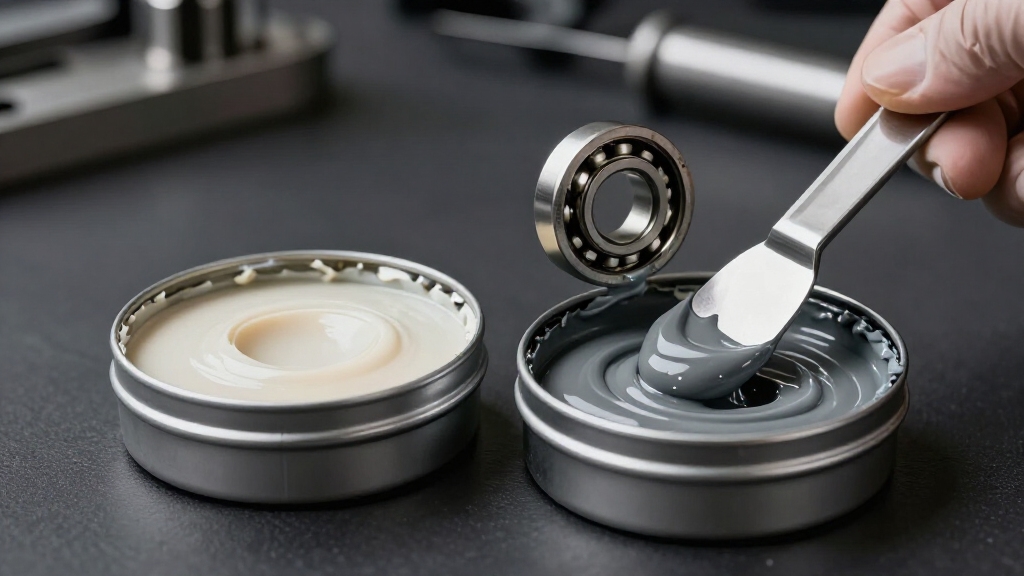
Understanding what lithium and moly greases are made of helps you select the right lubricant for your application.
Lithium grease consists of base oil thickened with lithium-based soap, serving as a versatile, general-purpose lubricant.
In contrast, moly grease builds on a conventional base, often lithium or lithium complex, but includes molybdenum disulfide (MoS2) as a solid additive.
This MoS2 content typically ranges between 1–5% by weight and provides extreme-pressure protection by acting as a solid lubricant.
The core distinction lies in the thickener system versus the additive: lithium refers to the soap thickener, while moly denotes the MoS2 additive.
Recognizing this difference enables you to anticipate performance traits and compatibility.
Moly’s solid particles alter friction and wear characteristics under demanding conditions.
Many high-performance moly greases, such as the Valvoline VV986 Heavy-Duty Synthetic Grease, combine synthetic bases with molybdenum disulfide for enhanced temperature stability and heavy-load resistance.
When it comes to handling moderate loads, lithium grease really shines. It provides solid lubrication under typical operating conditions, so you can trust it to keep things running smoothly.
On the other hand, if you’re dealing with shock or extreme pressure situations, moly grease is where it’s at. Thanks to the addition of molybdenum disulfide, it does a fantastic job of reducing metal-to-metal contact, which is crucial in those high-stress scenarios.
When you subject machinery to varying loads, the choice between lithium and moly greases becomes critical for performance and protection.
Lithium grease handles moderate loads effectively, maintaining a stable lubricating film under routine mechanical stresses.
However, when dealing with heavy loads or slow-speed, high-pressure contacts, moly grease outperforms lithium by leveraging molybdenum disulfide particles.
These solid lubricants embed in surface imperfections, reducing friction and metal wear during load peaks.
You’ll find moly grease particularly advantageous in applications where standard greases risk extrusion or film breakdown.
Conversely, lithium grease suits general-purpose scenarios where load demands remain within typical operational ranges.
Selecting the appropriate grease hinges on accurately evaluating load profiles.
Moly grease provides superior load handling in demanding environments, while lithium grease guarantees reliable protection under standard load conditions.
For extended service life and resistance to mechanical breakdown under heavy loads, some lithium greases incorporate extreme pressure additives to enhance their performance.
Although both lithium and moly greases serve as effective lubricants, their performance under shock and pressure varies markedly due to their composition.
Lithium grease, with its lithium-based soap thickener, handles typical loads efficiently but may struggle under heavy shock or extreme pressure.
In contrast, moly grease incorporates molybdenum disulfide particles that act as solid lubricants, filling microscopic surface irregularities and reducing metal-to-metal contact during sudden load spikes.
This makes moly grease particularly suited for severe-duty applications, where standard lithium grease might be displaced.
You’ll find moly grease excels in conditions involving heavy shock loads and slow-speed oscillations by maintaining a protective film even when the oil film momentarily collapses.
Choosing between these greases hinges on load severity, with moly offering superior resistance to shock and extreme pressures.
For suspension components, selecting a grease with durability and stay-put ability is crucial to ensure long-lasting protection under varying pressures and conditions.
Because surface protection depends heavily on load conditions, understanding how lithium and moly greases interact with metal surfaces under varying pressures is essential.
Lithium grease forms a stable lubricating film under typical loads, effectively preventing direct metal contact and wear. However, when pressures spike, this film can thin or collapse, risking surface damage.
Moly grease, fortified with molybdenum disulfide particles, offers enhanced protection by embedding into surface asperities. This creates a solid lubricating layer that reduces metal-to-metal friction during heavy or shock loads.
These moly particles act sacrificially, compensating when the oil film breaks down. Therefore, under extreme loads, moly grease markedly outperforms lithium grease by preserving surface integrity.
Selecting the appropriate grease hinges on accurately matching load conditions to these distinct surface protection mechanisms. Additionally, lithium complex greases offer extreme pressure additives that improve their load capacity and resistance to wear under heavy-duty conditions.
Lithium grease frequently serves as the go-to lubricant for general-purpose applications due to its balanced combination of stability, water resistance, and compatibility with various bearing types.
You’ll find it ideal for routine maintenance tasks where moderate load and speed are common, such as in automotive chassis, electric motor bearings, and household machinery. Its thickener system guarantees consistent performance across a broad temperature range, while its hydrophobic properties reduce water contamination risks.
When you need a reliable lubricant that handles typical service conditions without the risk of excessive buildup, lithium grease fits perfectly. It’s less suited for extreme-pressure or slow-speed oscillating joints, but its versatility and cost-effectiveness make it the preferred choice for everyday lubrication challenges across diverse industrial and consumer equipment. Additionally, lithium-based greases with EP additives provide enhanced protection against heavy loads and shock, improving durability in demanding applications.
When your equipment faces heavy loads, shock pressures, or slow-speed oscillations, moly grease offers specialized protection that standard greases can’t match. You’ll benefit from molybdenum disulfide’s ability to fill microscopic surface imperfections, reducing metal-to-metal contact during extreme pressure events.
This sacrificial layer maintains lubrication even when the oil film breaks down, making moly grease ideal for excavator pins, kingpins, and heavily loaded joints. When selecting moly grease, consider the base grease formulation, typically lithium or lithium complex, to guarantee compatibility with operating conditions.
Avoid over-application, as excessive moly buildup can impair performance. Use moly grease strategically for components subjected to shock loads and slow oscillations, where conventional lithium greases might fail. Matching grease type to load and motion specifics ensures peak protection and longevity. Additionally, advanced EP additive packages in moly greases enhance water and contamination resistance for demanding environments.
Although both lithium and moly greases offer solid lubrication, their temperature tolerance and stability differ based on thickener chemistry and additive composition.
Lithium complex thickeners generally provide superior high-temperature resistance and maintain additive integrity better than simpler lithium soaps.
Moly grease, often built on lithium complex bases, benefits from both the thickener’s thermal stability and the solid lubricant’s protection under shock and vibration.
Consider these key aspects:
Lithium complex greases resist thermal breakdown, extending service life in elevated temperatures.
Moly additives don’t markedly increase temperature limits but improve performance under extreme pressure and mechanical stress.
Stability in moly greases depends on the base lithium complex system, not the moly itself.
High-temperature applications often favor lithium complex moly greases for combined thermal and mechanical resilience.
Understanding these differences helps you select grease optimized for your operating conditions.
Greases commonly exhibit varying degrees of water resistance and corrosion protection. This largely hinges on their base formulation and thickener chemistry rather than solely on the presence of molybdenum disulfide additives.
When you select lithium grease, you benefit from hydrophobic lithium-based thickeners that limit water absorption and provide consistent corrosion inhibition. Conversely, moly grease’s water resistance depends on its underlying lithium or lithium complex base, not the molybdenum disulfide itself.
While moly particles form a solid lubricating layer, they don’t inherently enhance corrosion protection. You should also consider corrosion inhibitors integrated into the grease formulation, as these play a critical role in preventing metal degradation.
Ultimately, your choice must weigh the grease’s base oil, thickener type, and additive package to guarantee peak resistance to moisture and corrosion under your specific operating conditions. Lithium complex bases provide enhanced water resistance and adhesion, making them especially effective in outdoor and wet environments.
You should keep in mind that moly grease can lead to surface buildup over time. This buildup might interfere with certain applications, which is definitely something to consider.
Also, the water resistance of moly grease isn’t always top-notch. It really depends on the specific formulation of the base grease.
And just a heads-up: moly grease isn’t a one-size-fits-all solution. It mightn’t perform well in routine tasks or high-speed lubrication scenarios, so it’s worth weighing your options before deciding.
When you apply moly grease, its molybdenum disulfide particles can gradually accumulate on surfaces, forming a solid coating. This buildup may interfere with component fit, leading to increased friction or binding in precise assemblies.
Over time, the moly layer can become brittle or uneven, reducing its lubricating efficiency. You should consider these points:
Moly buildup is common in slow-speed, heavily loaded joints with oscillating motion. Excessive coating can alter clearances, affecting performance in tight-tolerance parts.
Removal or cleaning requires solvents or mechanical action, complicating maintenance. In applications demanding clean metal interfaces, moly grease may introduce contamination risks.
Hence, moly grease’s solid additive, while protective under heavy loads, may limit suitability where surface buildup impacts function.
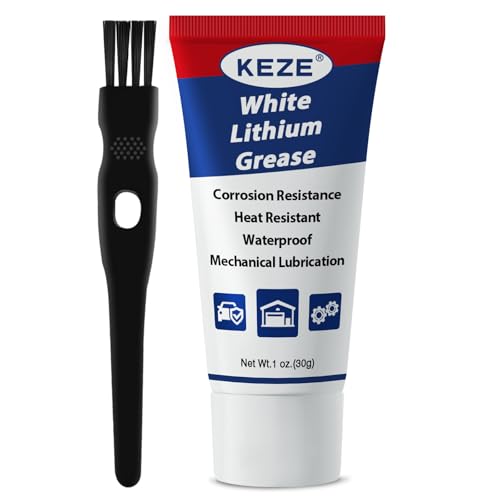
For applications requiring high-temperature tolerance and moisture resistance, white lithium greases such as Permatex 80345 offer a more stable alternative without the risk of solid buildup.
Beyond the concern of surface buildup, moly grease presents challenges with water resistance that can limit its effectiveness in certain environments. Unlike lithium grease, which generally exhibits good hydrophobic properties, moly grease’s water resistance depends heavily on its base formulation.
If the underlying thickener and additives don’t resist water well, moly grease may allow moisture ingress. This can reduce lubrication quality and promote corrosion.
Lithium or lithium-complex thickeners often provide superior water resistance and washout protection compared to moly-based formulations.
| Property | Moly Grease |
|---|---|
| Base Grease Dependence | Critical for water resistance |
| Water Ingress Risk | Higher if base lacks hydrophobicity |
| Corrosion Protection | Variable, depends on inhibitors |
| Surface Coating Impact | MoS2 buildup can trap moisture |
| Application Limitation | Not ideal for wet or submerged use |
You should carefully evaluate water exposure before selecting moly grease.
Although moly grease offers significant advantages under heavy loads and extreme conditions, it’s not always the best choice for every lubrication scenario. You need to evaluate the specific application carefully before switching to moly grease.
Its solid MoS2 particles can accumulate on surfaces, potentially causing buildup that impedes smooth operation. Over-application may lead to excessive friction or contamination issues. Additionally, moly grease formulations vary, so its water resistance and corrosion protection mightn’t outperform lithium-only greases.
Consider these limitations when choosing moly grease:
Select the grease type based on load, speed, and environmental demands rather than assuming moly is a universal upgrade. For example, some applications may benefit from anti-seize lubricants designed to prevent galling and corrosion under high temperatures and heavy pressure.
Since different equipment demands vary widely in load, speed, and operating conditions, selecting the right grease, lithium or moly, requires careful assessment of these factors.
You should choose lithium grease for general-purpose lubrication, moderate loads, and higher-speed applications due to its good water resistance and thermal stability.
Conversely, moly grease is best suited for slow-speed, heavily loaded, or shock-loaded joints where molybdenum disulfide’s solid lubrication prevents metal-to-metal wear during pressure spikes.
Consider the motion pattern and environmental exposure. Lithium complex greases offer enhanced temperature tolerance and additive retention, while moly’s coating buildup may be problematic in some systems.
Always match grease specification to manufacturer recommendations and operational demands rather than assuming moly is a universal upgrade. This ensures peak equipment performance and longevity.
You generally shouldn’t mix moly grease with lithium grease without confirming compatibility.
Differences in thickener types or additives may cause separation or reduced performance.
If both greases share a lithium complex base, mixing might be safer.
However, moly’s solid particles could alter consistency and wear protection.
Always check manufacturer recommendations and consider the application’s load, temperature, and contamination risks before combining greases.
This helps avoid compromising lubrication quality.
“An ounce of prevention is worth a pound of cure.”
You should reapply moly grease less frequently than lithium grease because moly’s solid MoS2 particles provide longer-lasting protection under heavy loads and shock.
Lithium grease, suited for lighter, general use, typically needs more regular reapplication.
However, always consider operational conditions. Extreme pressure or contamination demands may alter intervals.
Follow equipment guidelines and monitor wear to optimize re-lubrication timing accurately.
Yes, you should handle moly grease disposal carefully due to its molybdenum disulfide content.
MoS2 can persist in the environment, potentially affecting soil and water quality. You must follow local regulations for hazardous waste disposal to prevent contamination.
Avoid dumping moly grease into drains or soil. Proper collection and recycling or disposal at authorized facilities minimize environmental risks.
Always check material safety data sheets and comply with environmental guidelines when discarding moly grease.
Yes, moly grease can extend machinery lifespan under heavy loads and shock conditions by reducing metal-to-metal wear through its solid lubricant particles.
However, if used improperly or excessively, moly buildup may cause issues.
Lithium grease supports longevity in typical applications by providing stable, water-resistant lubrication.
You should match grease type to operating conditions to optimize machinery durability, avoiding overuse of moly grease where its benefits aren’t necessary.
You can use lithium grease in some marine or underwater applications, but you need to check its specific water resistance rating.
Lithium greases generally offer good water resistance and corrosion protection. Yet prolonged exposure to heavy water washout may reduce effectiveness.
For peak performance, select lithium greases formulated with hydrophobic thickeners and corrosion inhibitors designed for wet environments. This will guarantee durability and protection in marine conditions.
When choosing between lithium and moly grease, think of them as specialized tools in your mechanical toolbox.
Lithium grease offers versatile temperature resilience and water resistance, making it your go-to for everyday applications.
Moly grease stands firm under heavy loads, like a steadfast guardian against extreme pressure.
By matching their unique properties to your equipment’s demands, you guarantee peak performance and longevity.
This turns your machinery into a well-oiled symphony of precision and durability.
Last update on 2026-11-23 / Affiliate links / Images from Amazon Product Advertising API