Physical Address
304 North Cardinal St.
Dorchester Center, MA 02124
Physical Address
304 North Cardinal St.
Dorchester Center, MA 02124
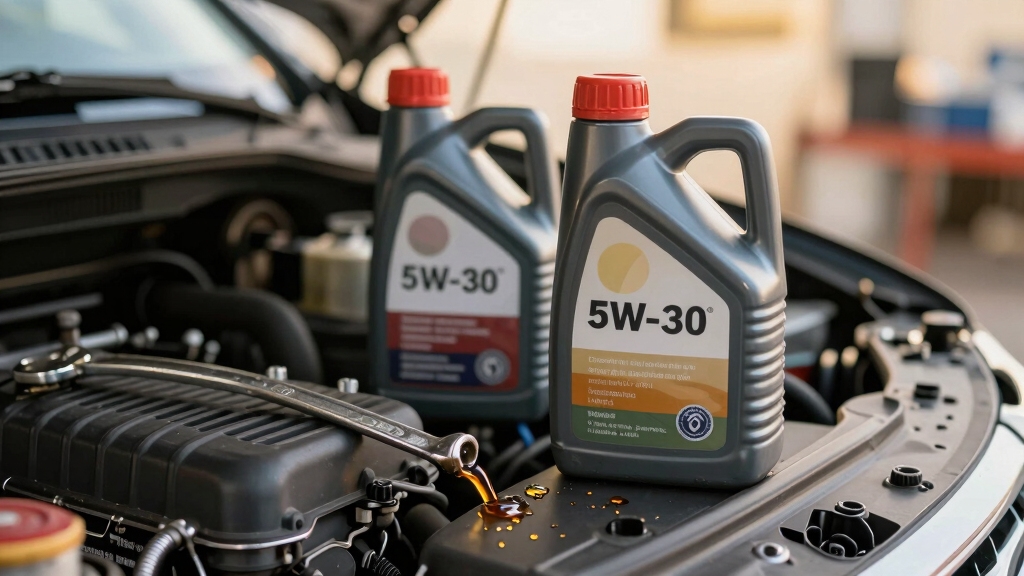
You can use 5W-30 instead of 10W-30 if your vehicle operates in cold or variable climates. 5W-30 flows more easily during startup and provides faster lubrication, reducing wear.
However, for older engines or warmer regions, 10W-30’s thicker cold viscosity better maintains oil pressure and film strength. Always follow your manufacturer’s specifications to avoid risks like insufficient oil pressure or premature wear.
Explore how climate, engine age, and conditions affect the best oil choice.
When you choose between 5W-30 and 10W-30 engine oils, understanding their viscosity ratings is essential for peak engine performance.
The first number, before the “W,” indicates cold-weather viscosity; lower numbers mean the oil flows more easily at low temperatures.
The “W” stands for winter, with this rating measured at -30°C (-22°F).
Both 5W-30 and 10W-30 share an identical second number, 30, representing viscosity at 100°C (212°F), the oil’s operating temperature.
This means both oils maintain the same thickness during engine operation.
However, at cold temperatures, 5W-30 flows more freely than 10W-30, enabling quicker circulation on startup.
Viscosity ratings like these help ensure the oil provides the right flow resistance for different temperature conditions, optimizing lubrication and minimizing wear.
When you fire up your engine in cold weather, you’ll notice that 5W-30 oil flows more quickly than 10W-30. Why is that? It’s all about the lower winter viscosity rating of 5W-30.
This quicker flow means that crucial components get the lubrication they need sooner, which can really help reduce startup wear. Oils with lower cold viscosity also maintain better pumpability below −18°C, ensuring faster lubrication during startup in harsh cold environments.
Although both 5W-30 and 10W-30 share the same high-temperature viscosity rating, 5W-30 flows markedly easier at cold temperatures. This ensures faster lubrication during engine startup.
This quicker flow reduces wear caused by delayed oil delivery, especially in harsh winters. Using 5W-30 improves cold start protection, while 10W-30’s thicker cold viscosity can slow initial lubrication.
Filters designed with silicone anti-drain back valves help maintain oil circulation during startup, further enhancing protection when using oils like 5W-30.
| Feature | 5W-30 | 10W-30 |
|---|---|---|
| Cold-Temperature Flow | Flows easily at -30°C | Thicker, slower flow |
| Startup Lubrication Time | Faster | Slower |
| Wear Protection on Start | Higher | Lower |
| Ideal Climate | Cold or variable | Mild to warm |
| Engine Type Suitability | Modern engines | Older/heavy-duty engines |
Because oil viscosity directly affects how quickly it circulates during cold starts, choosing between 5W-30 and 10W-30 hinges on their flow characteristics at low temperatures.
You’ll notice that 5W-30, with its lower cold viscosity rating, flows more readily at subzero temperatures. This ensures faster lubrication of engine components.
In contrast, 10W-30’s thicker cold viscosity can delay oil delivery during startup. This difference impacts engine protection and efficiency during cold weather operation.
5W-30 flows easier at startup, enhancing immediate lubrication.
10W-30 remains thicker, potentially restricting cold flow.
Both oils match viscosity at operating temperature (100°C).
Faster flow of 5W-30 reduces startup wear in cold climates.
10W-30 is better suited for warmer regions with less cold stress.
Understanding these flow traits helps you select the right oil for your environment.
However, using 10W-30 in cold climates can increase startup wear risk due to slower oil circulation during cold starts.
The improved cold flow characteristics of 5W-30 directly contribute to reducing engine wear during startup.
Because 5W-30 maintains lower viscosity at subzero temperatures, it reaches critical engine components faster than 10W-30. This minimizes dry metal-to-metal contact.
In cold conditions, 10W-30’s higher cold viscosity delays lubrication, increasing abrasive wear during initial cranking. This makes 5W-30 particularly advantageous for cold climates or vehicles frequently exposed to low temperatures.
Both oils share identical viscosity at operating temperature (100°C), so wear protection during normal running is comparable.
However, the enhanced startup lubrication of 5W-30 can extend engine life by reducing wear cycles caused by cold starts.
Using 5W-30 in appropriate climates optimizes wear reduction without sacrificing performance. It aligns with modern engine requirements for rapid oil flow under cold conditions.
Additionally, selecting oil that meets manufacturer specifications ensures optimal engine performance and protection.
You’ll find that 5W-30 flows much faster at low temperatures compared to 10W-30. This means quicker lubrication during those cold starts, which is pretty important. When the oil moves rapidly, it helps reduce startup wear by minimizing that pesky dry metal-to-metal contact, especially in harsh winter conditions.
Additionally, 5W-30’s superior cold-start performance ensures better engine protection and fuel efficiency during seasonal temperature swings.
How quickly your engine oil flows during cold starts critically affects engine protection, especially in winter conditions.
5W-30 oil features a lower cold-weather viscosity rating than 10W-30, which means it remains thinner and flows more readily at subzero temperatures. This faster flow guarantees essential engine parts receive lubrication sooner, reducing the risk of wear.
5W rating means oil stays fluid at temperatures as low as -30°C (-22°F).
Thinner cold viscosity improves pumpability during initial startup.
10W-30’s higher cold viscosity delays oil circulation in freezing climates.
Faster cold flow reduces component friction in early minutes after start.
Enhanced lubrication efficiency supports modern engines in cold regions.
Choosing 5W-30 optimizes cold start performance by guaranteeing rapid oil delivery when it matters most.
Many top synthetic oils, such as Mobil 1 Triple Action Formula, provide exceptional low-temperature protection to support these benefits.
Because 5W-30 oil flows more quickly at low temperatures, it markedly reduces startup wear by ensuring critical engine components receive lubrication immediately upon ignition.
When you start your engine in cold conditions, 5W-30’s lower cold-viscosity rating enables it to circulate faster than 10W-30. This minimizes the duration of metal-to-metal contact before full oil pressure builds.
This rapid lubrication limits abrasive wear during the vital initial seconds after startup, when most engine damage occurs. Using 5W-30 helps maintain a protective oil film on bearings, camshafts, and pistons sooner, reducing friction and mechanical stress.
If you live in colder climates or frequently start your vehicle after extended downtime, 5W-30’s superior cold flow properties provide a measurable advantage in preserving your engine’s longevity during winter starts. Additionally, maintaining optimal transmission temperatures is equally important for prolonging overall vehicle component life.
When temperatures plunge in harsh winter conditions, 5W-30 oil performs markedly better than 10W-30 by maintaining faster fluidity during cold starts.
You’ll notice that 5W-30 offers a lower cold-viscosity rating, allowing it to flow quickly to critical engine components. This reduces wear caused by delayed lubrication.
This characteristic is essential for modern engines operating in subzero climates, where rapid oil circulation prevents damage during startup.
Choosing 5W-30 guarantees peak protection and performance during winter, unlike 10W-30’s slower cold flow.
Its superior cold-start performance helps maintain precise lubrication and minimize engine wear during freezing conditions.
Typically, you’ll want to choose 10W-30 oil if you operate your vehicle in consistently warm climates or have an older engine with higher mileage.
The thicker cold viscosity of 10W-30 guarantees sufficient oil film strength during startup in warm regions where cold starts are less severe.
Additionally, older engines with wear benefit from the slightly thicker oil, which maintains better oil pressure and reduces metal-to-metal contact.
It is important to use oils that meet the manufacturer specifications to ensure engine protection and performance.
| Condition | 10W-30 Benefit |
|---|---|
| Warm climates | Maintains stable viscosity |
| Older engines | Improved oil pressure and sealing |
| High-load scenarios | Enhanced wear protection |
In these contexts, 10W-30 offers reliability and protection that 5W-30 may not fully provide, especially under sustained heat and higher engine wear.
At 212°F, both 5W-30 and 10W-30 have the same SAE 30 viscosity. This means they flow pretty similarly when your engine is running.
But there’s a little twist with 10W-30—it has a slightly thicker oil film. This can be helpful in high-heat or heavy-load situations, especially if you’re driving an older engine.
On the flip side, 5W-30 tends to offer better fuel economy and stability, mainly because of its synthetic blends. However, once your engine reaches full temperature, the performance difference between the two oils becomes less significant. So, it really depends on your specific needs!
Viscosity at 212°F plays a vital role in engine performance. Both 5W-30 and 10W-30 oils maintain the same SAE 30 rating at this operating temperature. This means they provide equivalent resistance to flow under normal engine heat, guaranteeing consistent lubrication and protection.
When you compare these oils at 212°F, you’ll find no significant difference in thickness. This directly influences the oil film strength on critical engine parts.
Key points to consider:
Choosing between them won’t affect engine protection at typical operating heat.
While both 5W-30 and 10W-30 oils maintain the same SAE 30 viscosity at engine operating temperatures, subtle differences emerge under high-heat, high-load conditions.
You’ll find that 10W-30’s slightly thicker baseline provides a marginally more robust oil film, which can enhance stability during extended high-temperature operation. This thickness can be particularly beneficial in older or heavily worn engines where maintaining oil pressure is critical.
Conversely, 5W-30, often formulated as semi- or fully synthetic, offers improved thermal and oxidative stability, which supports consistent viscosity but may result in a slightly thinner protective film under extreme heat.
In practical terms, you can expect 10W-30 to perform better in continuous heavy-duty scenarios, while 5W-30 suits modern engines with variable loads, balancing efficiency and thermal resilience without compromising flow properties at operating temperature.
Evaluating engine protection at operating temperature reveals that both 5W-30 and 10W-30 oils deliver comparable lubrication due to their identical SAE 30 viscosity rating at 212°F.
This means you get similar film strength and wear protection once the engine reaches normal operating heat.
Differences mainly appear during cold starts, not in sustained high-temperature conditions.
When selecting one over the other, consider engine design, operating environment, and load conditions.
Key points on engine protection include:
Both maintain consistent viscosity to prevent metal-to-metal contact.
10W-30 offers slightly thicker oil film under extreme load.
5W-30’s synthetic variants enhance thermal stability.
Similar anti-wear additive packages across formulations.
Proper viscosity guarantees oil pressure and optimal lubrication.
Thus, at operating temperature, neither oil compromises engine durability.
Because both 5W-30 and 10W-30 oils maintain the same SAE 30 viscosity at high operating temperatures, their longevity largely depends on formulation and operating conditions rather than viscosity grade alone.
Typically, 5W-30 oils are synthetic or semi-synthetic, offering better oxidation resistance and longer drain intervals. Conversely, 10W-30’s slightly thicker cold viscosity can marginally enhance stability under sustained high-heat loads.
Your choice should consider driving habits, climate, and oil quality.
| Factor | 5W-30 | 10W-30 |
|---|---|---|
| Base Oil Type | Synthetic/Semi-synthetic | Conventional/Semi-synthetic |
| Cold Weather Start | Faster flow, reduced wear | Thicker, slower startup flow |
| High-Temperature Stability | Excellent oxidation resistance | Slightly higher viscosity stability |
| Drain Interval | Longer with modern formulations | Standard intervals |
| Ideal Use Cases | Variable climates, modern engines | High-heat, heavy load engines |
Although using 5W-30 instead of 10W-30 is generally safe with modern synthetic formulations, you should consider potential risks related to oil pressure and engine wear.
Thinner 5W-30 oil may reduce oil pressure, especially in high-mileage engines with worn clearances. This could lead to inadequate lubrication.
Using thinner 5W-30 oil can lower oil pressure, risking inadequate lubrication in older engines with worn clearances.
Additionally, 5W-30’s lower cold viscosity mightn’t provide the thicker oil film some older engines require under load or high heat.
This increases wear risks, and over time, this mismatch could accelerate component fatigue.
Key risks include:
Evaluate these factors carefully before substituting oils.
When selecting the right oil for your vehicle, you need to take into account both the engine type and the operating conditions to guarantee peak performance and longevity.
Modern light-duty engines often benefit from 5W-30 oil, which flows more easily during cold starts. This reduces wear and improves startup protection in colder climates.
Conversely, 10W-30 is better suited for older engines or heavy-duty vehicles that operate under high heat or load. The thicker cold viscosity helps maintain oil pressure and durable film strength.
You should also consider ambient temperature. If you regularly drive in warmer regions, 10W-30 provides stable protection, while 5W-30 excels in variable or cold environments.
Always follow your vehicle manufacturer’s viscosity recommendations to avoid premature wear or lubrication issues.
If you want to maximize fuel efficiency, choosing between 5W-30 and 10W-30 engine oils can make a measurable difference. The thinner cold viscosity of 5W-30 reduces internal engine friction during startup and warm-up phases. This improves fuel economy, especially in cooler climates.
Selecting 5W-30 oil lowers engine friction at startup, boosting fuel efficiency, particularly in colder weather.
Both oils share identical high-temperature viscosity, so differences mainly arise at lower temperatures. Modern 5W-30 formulations often include synthetic blends that further enhance flow and reduce drag on engine components.
5W-30 flows more easily at startup, cutting initial fuel use. Reduced engine drag from thinner oil improves mileage. 10W-30’s thicker cold viscosity slightly increases fuel consumption. Both oils perform equivalently at full operating temperature.
Synthetic 5W-30 variants can offer marginal fuel savings over conventional 10W-30. Choosing 5W-30 consequently supports better efficiency without sacrificing protection.
Improving fuel economy by selecting the right oil viscosity, such as 5W-30 over 10W-30, highlights the importance of matching oil characteristics to your vehicle’s requirements.
Your owner’s manual specifies oil viscosity to guarantee optimal lubrication, wear protection, and engine performance under expected operating conditions.
Deviating from these recommendations risks inadequate oil pressure or film thickness, especially in high-mileage or older engines.
Modern engines benefit from thinner cold-start viscosities like 5W-30 for reduced friction and quicker oil flow, but this may not suit all engines.
The manual accounts for ambient temperature ranges, engine design, and load profiles, balancing cold start protection with hot operating stability.
Following it assures the selected oil viscosity maintains the engineered tolerances and longevity, preventing premature wear or efficiency losses that could arise from improper oil substitution.
Mixing 5W-30 and 10W-30 oils generally won’t harm your engine immediately, since both share similar high-temperature viscosity.
However, you risk inconsistent flow properties during cold starts and potential variations in oil pressure, especially in older or high-mileage engines.
For peak performance and protection, you should avoid mixing viscosities and stick to the manufacturer’s recommended grade.
Consistency guarantees stable lubrication and minimizes wear over time.
You can often extend oil change intervals by up to 50% when using synthetic 5W-30 compared to conventional oils.
Synthetic 5W-30 resists breakdown better, maintains viscosity longer, and handles high temperatures more effectively.
However, always follow your vehicle manufacturer’s recommendations, since factors like driving conditions and engine age impact oil life.
Monitoring oil quality and levels regularly guarantees peak protection and performance without unnecessary early changes.
Oil viscosity directly impacts engine noise and smoothness by influencing the lubrication film thickness between moving parts.
Thicker oil (higher viscosity) creates a more robust film, reducing metal-to-metal contact and damping mechanical noise, enhancing smoothness.
Conversely, thinner oil flows faster but may produce more noise due to reduced cushioning, especially at startup.
Selecting the correct viscosity guarantees peak balance, minimizing noise and vibration while maintaining efficient component protection under operating conditions.
Think of oil additives as the secret spice blend in your engine’s recipe.
You won’t find unique additives exclusive to 5W-30 or 10W-30 oils; both share similar additive packages like detergents, anti-wear agents, and antioxidants.
The difference lies mainly in base oil viscosity and formulation, with 5W-30 often being synthetic for better cold flow.
Using 5W-30 in your turbocharged engine generally supports peak performance.
Its lower cold viscosity guarantees quicker lubrication at startup, reducing turbo bearing wear.
Since both 5W-30 and 10W-30 match viscosity at operating temperature, oil flow under high heat remains stable.
However, make certain the 5W-30 meets your manufacturer’s specifications for turbo engines.
Synthetic formulations often provide better thermal stability and deposit control, essential for turbocharged components.
Choosing between 5W-30 and 10W-30 isn’t just about numbers; it’s about how your engine responds in real conditions. While 5W-30 offers superior cold starts and fuel efficiency, 10W-30 provides stability in warmer climates and older engines.
Using the wrong oil risks wear and performance loss. Balancing these factors against your vehicle’s needs and environment guarantees peak protection. Don’t gamble with your engine. Follow your owner’s manual and choose precisely.