Physical Address
304 North Cardinal St.
Dorchester Center, MA 02124
Physical Address
304 North Cardinal St.
Dorchester Center, MA 02124
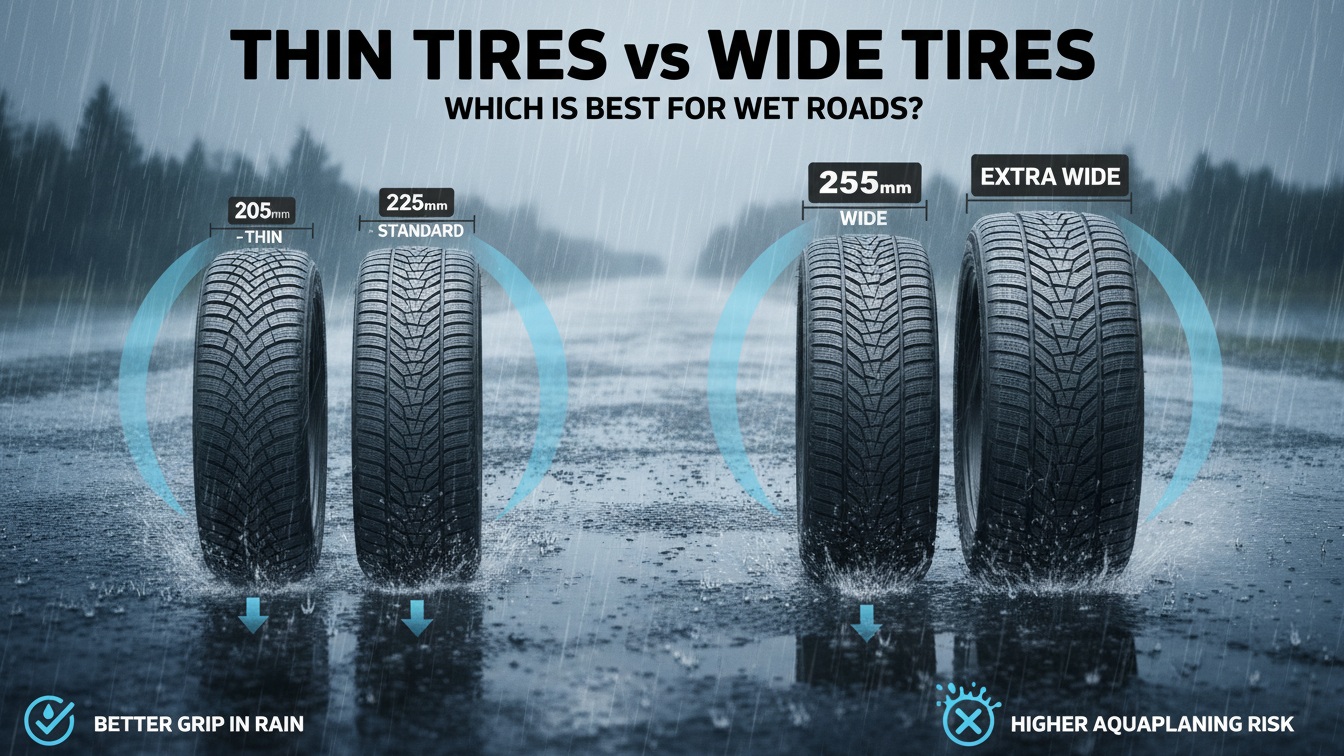
You should pick tire width based on your driving needs and terrain. Thin tires concentrate pressure for better grip on snow, ice, and soft surfaces. They cut through mud while reducing hydroplaning risk.
Wide tires offer a larger, oval contact patch that boosts cornering stability and load capacity. However, they increase steering effort and fuel consumption. Both affect handling, durability, and efficiency differently.
Understanding these trade-offs helps optimize performance and safety for your specific conditions. Explore how each factor influences your choice.
| Aspect | Thin Tires Advantage | Wide Tires Advantage |
|---|---|---|
| Snow/Ice Grip | Cuts through for better penetration and braking | Larger patch but risks clogging in deep snow |
| Mud/Sand Off-Road | Digs to firm ground, self-cleans effectively | Floats on surface, spreads weight widely |
| Wet Handling | Lower hydroplaning risk, slices water better | Needs strong treads; higher risk if inadequate |
| Dry Stability | Nimble steering, less effort | Superior cornering, lateral grip at speed |
| Fuel Efficiency | Lighter weight, lower rolling resistance | Heavier, higher consumption from mass |
| Load Capacity | Suitable for light loads, agile handling | Supports heavier weights, durable sidewalls |
Although both thin and wide tires share nearly the same contact patch area, they differ distinctly in shape. Wide tires form a shorter, wider patch often resembling an oval, while thin tires produce a longer, narrower patch closer to a rectangle.
Thin and wide tires share contact area but differ: wide tires have oval patches, thin tires rectangular.
When you lower tire pressure, both types expand their patches in length and width. Wide tires increase width considerably, while thin tires extend length. This contradicts the common belief that only patch length grows.
The narrow tire consistently produces a longer contact patch than the wide tire at similar pressures, highlighting how contact patch length varies with tire width. This variation in shape impacts the tire’s ability to distribute forces, similar to how gear tooth count affects wrench performance.
At very low pressures, wide tires maximize tread contact width and length, altering patch geometry. Understanding these distinctions is essential since patch shape impacts handling dynamics, traction distribution, and rolling resistance.
In your analysis, consider that the contact patch shape results from tire width, pressure, and load, influencing performance characteristics uniquely for thin versus wide tires.
When maneuvering snow and ice, tire width considerably influences traction and handling, yet its impact often pales compared to tire quality. Narrow tires excel in deep snow and ice by concentrating contact pressure, improving grip and shortening braking distances by up to 3 meters on snow.
However, the tread pattern plays a critical role in overall winter performance, often more so than width alone. Middle-width tires sometimes outperform extremes, reflecting an ideal width range. On ice, differences between widths shrink, with quality tread and compound dominating performance.
Narrow tires cut through snow, enhancing acceleration and control. Wider tires risk snow packing, reducing effectiveness in deep snow.
Ice braking distances between widths vary by less than 0.5 meters. Handling differences are subtle; tire compound outweighs width effects. Choosing a high-quality winter tire trumps width selection in snowy and icy conditions.

When you’re navigating through mud and sand, wide tires can really make a difference. They help your vehicle float better by spreading its weight over a larger area.
This significantly reduces the chance of getting stuck, which is something we all want to avoid, right? Wide tires provide better flotation on soft terrain by increasing the tire-road contact patch. They also help maintain traction stability in low-traction environments.
On the flip side, narrow tires have their own advantages. They concentrate force on a smaller footprint, which allows them to dig deeper into those soft surfaces. This can actually help you reach firmer ground below the muck, improving your vehicle’s ability to maneuver through challenging terrain.
Since wider tires distribute a vehicle’s weight over a larger surface area, they considerably reduce ground pressure on soft substrates like mud and sand. This reduction in ground pressure, measured in kN/m², improves flotation by preventing the tires from sinking deeply.
However, note that tyre pressure is the dominant factor in sand driving, outweighing size or tread pattern. Additionally, selecting tires with the appropriate filtration efficiency of contaminants can indirectly influence vehicle performance in challenging terrain.
You’ll find that airing down wide tires further increases the contact patch, enhancing this effect especially when the soft material depth exceeds 110% of your vehicle’s ground clearance. The wider tread area allows your vehicle to maintain momentum by minimizing penetration into the substrate.
Wide tires maximize flotation when tire pressure is adjusted to soft surface conditions. They reduce the risk of bogging down by spreading load and displacing substrate efficiently.
Smooth, wide tread designs optimize traction by limiting lateral substrate displacement. Flotation benefits peak with deep mud or sand, where substrate depth challenges narrow tires.
Although wide tires excel at flotation, narrow tires penetrate soft substrates like mud and sand more effectively by concentrating ground pressure on a smaller contact patch.
This higher pressure allows narrow tires to cut through soft layers and reach firmer ground beneath, reducing drag and improving forward momentum. Their reduced surface area minimizes mud clogging, maintaining traction during rotation.
Additionally, narrow tires often provide better cold start behavior in off-road conditions, enhancing performance in harsh environments. Tread designs with widely spaced, directional lugs promote self-cleaning and mechanical grip, which are vital for off-road conditions.
In sandy or silty mud, slightly lowered tire pressures increase contact without excessive sinking. Mechanical interlocking with terrain irregularities enhances grip in such conditions.
Narrow tires also avoid clearance issues in technical terrain. By optimizing penetration, you reduce the risk of bogging down and maximize traction where firm substrate lies beneath soft surfaces, making narrow tires ideal for technical off-road trails with frequent mud patches.
Because hydroplaning can cause a sudden loss of traction, understanding how tire width affects wet weather handling is critical for safe driving.
Recognizing tire width’s impact on wet traction is essential to prevent hydroplaning and ensure driving safety.
Wider tires increase the contact area but can trap more water, raising hydroplaning risk if tread design and water evacuation are inadequate. Advanced additive technology in tire compounds can improve grip even in such challenging conditions.
Narrower tires focus pressure on a smaller patch, cutting through water more effectively and reducing hydroplaning likelihood. Still, tread pattern, inflation pressure, water depth, and speed strongly influence safety in wet conditions.
Efficient tread designs with deep channels improve water displacement for all tires. Manufacturers emphasize the importance of water channeling grooves to enhance hydroplaning resistance, especially in wider tires.
Wider tires generally hydroplane at lower speeds than narrower ones under similar conditions. Proper tire pressure maintains ideal contact and minimizes hydroplaning risk. Water depth and road texture critically affect hydroplaning onset regardless of tire width.

When choosing between thin and wide tires, you’ll notice they markedly influence your vehicle’s handling and stability through variations in contact patch shape, steering response, and cornering dynamics.
Wide tires create a wider, shorter contact patch that enhances lateral grip, improving cornering stability and reducing body roll at high speeds. However, they increase steering effort and can dull feedback, potentially compromising agility during rapid direction changes.
They can also increase aerodynamic drag and rolling resistance, impacting fuel efficiency due to their size and shape. Proper maintenance, including regular inspections and cleaning, is essential to preserve tire performance and safety maintenance tips.
Thin tires generate a longer, narrower contact patch, providing better longitudinal grip for acceleration and braking, alongside lighter, more direct steering feel that improves nimbleness and reduces tramlining. They also conform better to uneven surfaces, maintaining consistent traction.
Ultimately, the ideal tire width balances lateral traction with steering precision, influenced by your vehicle’s suspension and intended driving conditions. Consulting with experts can help tailor tire choices to specific performance goals and terrain expert consultation.
You know, it’s interesting how tire width plays a role in load capacity. Wider tires usually support heavier loads because they’ve more air volume and stronger sidewalls.
On the flip side, thinner tires tend to have lower load capacities but they keep the overall weight down. This difference really does affect vehicle efficiency. Heavier tires can increase unsprung mass, which in turn raises fuel consumption.
Additionally, larger sidewalls increase tire pliability and deformation ease, which can influence how the tire supports weight under load tire structure. Moreover, just like brake fluid types affect vehicle performance, choosing tires that match load capacity requirements is crucial for safety and efficiency.
Although both thin and wide tires can support vehicle loads exceeding typical requirements, their load capacity and weight characteristics differ considerably.
Wide tires have greater air volume, enabling them to carry equivalent loads at lower inflation pressures. Conversely, thin tires are generally lighter, reducing unsprung mass and improving handling dynamics. You’ll need to contemplate these trade-offs carefully. Proper load support is essential for safety and tire longevity.
Wide tires deform less under load due to higher air volume, enhancing durability. Additionally, the vehicle’s suspension design often has a greater impact on load distribution than tire width alone, making the interplay between suspension and tire choice crucial for optimal performance suspension influence.
Thin tires often feature higher load ratings but may sacrifice ride comfort due to stiffness. Reduced weight of narrow tires lowers tire bounce and drivetrain strain, benefiting fuel economy. Load rating mismatches can impair performance; matching tire construction to vehicle use is critical.
Since tire weight directly influences vehicle dynamics, choosing between thin and wide tires impacts efficiency beyond just load capacity.
Narrow tires weigh less due to reduced material use, lowering unsprung mass and rotational inertia. This enhances fuel economy, acceleration, and braking responsiveness. Additionally, narrow tires offer better tracking and less tendency to follow ruts and grooves on paved roads, contributing to smoother handling and efficiency.
This weight advantage is especially significant in multi-tire vehicles, where it marginally increases payload capacity. Proper maintenance practices can help ensure tires perform optimally over time.
While wide tires support higher loads without raising inflation pressure, their added weight and stiffer sidewalls raise rolling resistance. This reduces overall efficiency. Narrow tires with appropriate load ratings optimize efficiency for light-duty applications by minimizing unnecessary weight and resistance.
Therefore, matching tire width precisely to load requirements maximizes efficiency. This balances load support with benefits derived from lower tire weight and improved vehicle dynamics.
When you increase tire width or diameter, you also add to the vehicle’s rotating mass, which demands more energy to accelerate and maintain speed. This increase in rotating mass directly impacts fuel efficiency, especially during stop-and-go driving where acceleration occurs frequently.
Heavier, wider tires not only raise rolling resistance but also require the engine to exert additional torque to overcome inertia. Regularly inspect for dirt and debris on tires to prevent increased resistance and maintain optimal performance.
Conversely, reducing tire weight through advanced materials helps improve fuel economy. Additionally, using the smallest tires recommended for your vehicle helps optimize fuel efficiency. Keep in mind these critical factors:
You’ll notice that wider tires generate more noise at highway speeds due to their larger contact patch, which amplifies vibrations and air turbulence. This effect increases as speed rises, making noise from wider tires more pronounced.
Narrow tires maintain lower noise levels because their smaller footprint reduces these factors. However, tread design and road surface also influence noise, so while width matters, it’s not the sole noise determinant during highway driving.
Imagine your tires like shoes: narrow ones fit snugly, wearing evenly, while wide ones are like oversized boots that flex more, causing uneven wear. You’ll notice narrow tires usually show consistent tread wear due to stiffer sidewalls and higher pressure tolerance.
Wide tires often develop center or shoulder wear if improperly inflated, as their larger contact patch flexes more. Proper rotation and inflation are key to managing these distinct wear patterns effectively.
You’ll find that wide tires considerably reduce braking distances on dry pavement compared to narrow tires. Their larger contact patch increases friction and distributes weight more evenly, enhancing grip and stability during braking.
Tests show wide tires can shorten stopping distances by over five meters at 100 km/h. While tire construction and compound also matter, width remains a primary factor in improving dry braking performance under emergency conditions.
You need to match tire width with the wheel’s recommended rim width range to guarantee proper fitment. Wider tires require correspondingly wider wheels to maintain correct sidewall profile and contact patch.
Mounting a tire on a rim outside its specified width range risks altering tire shape, reducing performance, and compromising safety.
Always consult manufacturer compatibility charts before selecting aftermarket wheels to preserve handling, avoid uneven wear, and maintain structural integrity.
Yes, tire width can affect your speedometer accuracy, but only indirectly.
Speedometers calculate speed based on tire circumference, primarily influenced by diameter. When you increase width without changing diameter, the rolling circumference changes minimally, causing slight speed reading variations.
However, if width changes alter tire profile and overall diameter beyond about 5%, speedometer errors become noticeable. To maintain accuracy, ensure the overall tire diameter stays close to factory specifications or recalibrate your speedometer.
When choosing between thin and wide tires, you’ll want to weigh their distinct advantages carefully. Wide tires offer a greater contact patch for improved stability and off-road traction, but can increase fuel consumption and the risk of hydroplaning.
Thin tires excel in snow, ice, and fuel efficiency but may struggle with load and wet grip. It’s clear that neither option is a one-size-fits-all; you’ve got to read the tea leaves of your driving conditions to select the best fit.