Physical Address
304 North Cardinal St.
Dorchester Center, MA 02124
Physical Address
304 North Cardinal St.
Dorchester Center, MA 02124
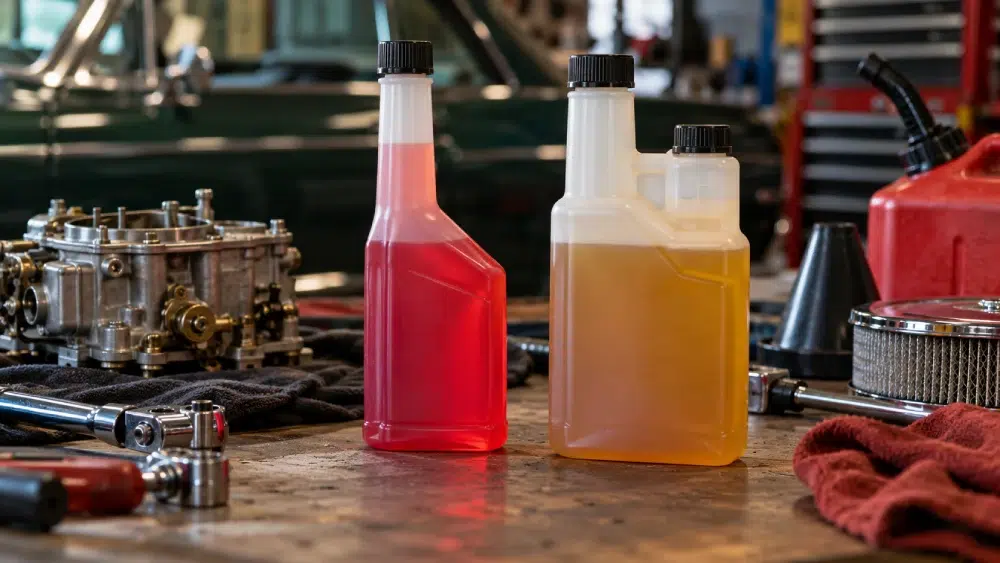
You’ll want PRI-G if you manage large fuel volumes or need multi-year storage. It’s ultra-concentrated and restores aged gasoline effectively at low doses.
STA-BIL works better for casual users with small engines or seasonal fuel. Its higher dose per gallon and moderate concentration make it a suitable choice.
PRI-G treats far more fuel per bottle, enhancing cost-efficiency and long-term preservation. If you need precise distinctions on dosage, restoration, and cost benefits, more detailed insights follow.

| Comparison Factors | PRI-G | STA-BIL |
|---|---|---|
| Primary Purpose | Long-term gasoline preservation and fuel conditioning | Gasoline stabilization and seasonal storage protection |
| Formula Concentration | Highly concentrated fuel treatment | Lower treatment concentration in the product compared by the article |
| Treatment Dosage | Approximately 1 oz per 16 gallons | Article states approximately 4 oz per 10 gallons |
| Example Bottle Size | 32 oz | 4 oz |
| Fuel Treatment Capacity | Up to 512 gallons per 32 oz bottle | Approximately 10 gallons per 4 oz bottle, using the article’s figures |
| Storage Duration | Article describes multi-year storage, potentially three years or more | Article describes up to 24 months for STA-BIL Storage |
| Fuel Oxidation Protection | Designed to help limit gasoline deterioration | Designed to help slow fuel oxidation and degradation |
| Aged Fuel Treatment | Marketed for conditioning aged gasoline | Primarily intended for preventive stabilization of fresh fuel |
| Corrosion Protection | Article highlights fuel-system corrosion protection | Article highlights corrosion protection during storage |
| Large Fuel Tanks | Well suited to bulk gasoline storage | Can be used for larger quantities with appropriate dosing |
| Small Engine Applications | Suitable for compatible gasoline-powered equipment | Convenient for lawnmowers, snowblowers, and seasonal equipment |
| Generator Fuel Storage | Useful for managing larger emergency fuel reserves | Useful for seasonal generator fuel storage |
| Application Convenience | Requires careful measurement of a concentrated dose | Straightforward dosing for smaller gasoline quantities |
| Fuel Compatibility | Article identifies compatibility with ethanol-free gasoline | Article identifies compatibility with ethanol-free gasoline |
| Overall Recommendation | Best suited to concentrated treatment and bulk storage needs | Best suited to routine seasonal storage and smaller fuel volumes |

When comparing PRI-G and STA-BIL fuel stabilizers, you’ll find that each product targets different user needs through distinct formulations and dosing strategies.
PRI-G is an ultra-concentrated, professional-grade additive designed for long-term storage and restoration of aged gasoline, dosed at approximately 1 ounce per 16 gallons.
PRI-G is a highly concentrated, professional additive for long-term fuel storage and rejuvenation of old gasoline.
In contrast, STA-BIL is a mainstream stabilizer formulated for seasonal storage and small engines, with a typical dose of 4 ounces per 10 gallons.
Due to its concentration, PRI-G offers a markedly lower cost per treated gallon and excels in bulk fuel management, including generators and large tanks.
STA-BIL prioritizes accessibility and affordability, packaged in smaller bottles with straightforward application for casual users.
The chemical composition and dosing efficiency distinctly define the operational roles of these stabilizers in fuel preservation.
Notably, STA-BIL Storage Fuel Stabilizer can keep gasoline fresh for up to 24 months, making it a reliable choice for extended seasonal storage.
When choosing a fuel stabilizer, it’s important to think about how long you’ll be storing your fuel. If you’re looking for something that can keep your fuel good for multiple years, PRI-G is a solid choice. On the other hand, if you’re only planning to store fuel for a season, STA-BIL might be more your speed.
Also, consider what you need in terms of restoration. PRI-G not only prevents issues but can also help rejuvenate aged fuel, which is a nice bonus. STA-BIL, while effective, mainly focuses on prevention.
Lastly, let’s talk about cost. PRI-G might’ve a higher upfront price, but when you break down the treatment cost per gallon, it often turns out to be more economical in the long run. So, weigh these factors carefully to find the right fit for your needs!
Additionally, understanding the dosage and treatment economy of each product can help ensure you use the right amount for your fuel volume and avoid waste.
Although both PRI-G and STA-BIL fuel stabilizers effectively preserve gasoline, their ideal storage durations differ markedly. This influences which product you should choose based on your fuel management needs.
PRI-G excels in multi-year storage, reliably maintaining fuel quality for up to three years or more. This makes it best for long-term fuel reserves like generators or bulk tanks.
In contrast, STA-BIL typically guarantees preservation for about 24 months under ideal conditions. It targets seasonal storage and smaller, more frequent fuel use.
If your priority is extended storage with minimal degradation risk, PRI-G’s ultra-concentrated formula provides superior protection over prolonged intervals. Conversely, if you need a cost-effective solution for shorter-term storage, STA-BIL offers adequate stabilization but lacks PRI-G’s enhanced longevity and robustness in long-duration scenarios.
Proper storage practices such as tight caps and temperature control can significantly extend the effectiveness of fuel stabilizers like STA-BIL.
Since fuel degradation can compromise engine performance and reliability, choosing a stabilizer with effective restoration capabilities is essential for maintaining gasoline quality.
PRI-G excels here by not only preventing oxidation but actively restoring aged fuel with higher dosing. STA-BIL, while effective for prevention, lacks significant restoration properties.
If you’re dealing with fuel stored months or years, PRI-G’s formulation can re-stabilize and extend usability, reducing waste and engine issues.
Many fuel treatments also incorporate rust and corrosion prevention to protect fuel systems during storage and use, enhancing overall engine longevity through corrosion protection.
| Feature | PRI-G | STA-BIL |
|---|---|---|
| Restoration Ability | High can restore degraded fuel | Low primarily preventative |
| Recommended Use | Long-term aged fuel | Short-term fresh fuel |
| Dosing for Restoration | Higher dose required | Not applicable |
| Engine Impact | Maintains performance | Prevents degradation |
Choose PRI-G for advanced restoration needs.
Evaluating cost efficiency between PRI-G and STA-BIL requires analyzing both upfront expense and fuel volume coverage.
PRI-G commands a higher initial price, yet its ultra-concentrated formula treats up to 512 gallons per 32-ounce bottle, markedly lowering cost per gallon.
In contrast, STA-BIL, sold in smaller bottles, treats roughly 10 gallons per 4-ounce container, making it more affordable upfront but less economical for large volumes.
If you manage bulk fuel or long-term storage exceeding 100 gallons, PRI-G offers superior value by reducing additive consumption and frequency of repurchase.
Conversely, for seasonal or small engine use with lower fuel volumes, STA-BIL’s accessible pricing and distribution may suit your needs better.
Ultimately, your choice hinges on fuel volume, storage duration, and budget priorities. Proper storage conditions are essential to maintain fuel stabilizer effectiveness over time.
You’ll notice that PRI-G has a significantly higher concentration, needing just about 1 ounce for every 16 gallons of fuel.
On the other hand, STA-BIL recommends around 4 ounces for 10 gallons.
This difference really adds up, meaning PRI-G can treat much larger volumes with a single bottle.
That’s not just about cost efficiency; it also plays a role in how you manage your storage.
Additionally, STA-BIL is known for its corrosion protection capabilities, which are crucial for maintaining fuel system integrity during long-term storage.
Although both PRI-G and STA-BIL stabilize gasoline, they differ markedly in concentration and dosing requirements.
PRI-G is ultra-concentrated, requiring about 1 ounce per 16 gallons, making it highly efficient for large volumes. STA-BIL demands a higher dosage ratio, around 4 ounces per 10 gallons, suited for smaller applications.
This concentration disparity affects cost-efficiency and treatment volume.
| Feature | PRI-G | STA-BIL |
|---|---|---|
| Dosage Ratio | 1 oz / 16 gallons | 4 oz / 10 gallons |
| Bottle Size | 32 oz | 4 oz |
| Treatment Volume | Up to 512 gallons | Approx. 10 gallons |
| Concentration Level | Ultra-concentrated | Moderate concentration |
| Ideal Use | Bulk storage, large tanks | Small engines, seasonal |
You’ll find PRI-G’s higher concentration advantageous for long-term, large-scale fuel stabilization. Additionally, STA-BIL’s formulation lowers the Cold Filter Plugging Point, helping maintain fuel flow in temperatures down to -40°F.
Understanding the differences in dosage ratios between PRI-G and STA-BIL naturally leads to examining how much fuel each bottle can treat.
PRI-G, dosed at approximately 1 ounce per 16 gallons, offers a 32-ounce bottle that treats up to 512 gallons.
In contrast, STA-BIL Storage, dosed roughly at 4 ounces per 10 gallons, treats only about 10 gallons per 4-ounce bottle.
This significant disparity reflects PRI-G’s ultra-concentrated formulation designed for bulk fuel management and long-term storage.
You’ll find PRI-G’s high treatment volume per bottle cost-efficient for large tanks and generators.
Meanwhile, STA-BIL’s smaller treatment capacity aligns with everyday small-engine needs and seasonal use.
Evaluating treatment volume per bottle underscores PRI-G’s advantage in handling extensive fuel quantities with fewer applications.
For optimal fuel preservation, it is important to apply stabilizers promptly and in the correct dosage to prevent fuel degradation during storage.
Frequently, the dosage differences between PRI-G and STA-BIL fuel stabilizers directly influence their effectiveness in storage duration and fuel condition retention.
PRI-G’s ultra-concentrated formulation requires roughly 1 ounce per 16 gallons, enabling treatment of up to 512 gallons per 32-ounce bottle. This low-dose approach supports multi-year storage and fuel restoration by maintaining chemical integrity longer and reversing early degradation.
Conversely, STA-BIL’s standard dose is about 4 ounces per 10 gallons, focusing on short-term, seasonal preservation. Higher dosage per gallon limits treated volume and may reduce cost-efficiency for bulk storage.
When you use PRI-G, you optimize long-term stability and restoration potential, while STA-BIL suits routine, smaller-scale applications. Your choice hinges on storage duration and fuel volume, with dosing directly impacting both efficacy and economic value.
Additionally, concentrated formulas like PRI-G and STA-BIL 360 provide corrosion protection alongside fuel stabilization, enhancing engine longevity during storage.
Typically, PRI-G can keep gasoline fresh for up to three years or more under proper storage conditions, outperforming STA-BIL, which generally maintains fuel stability for about 24 months.
PRI-G’s ultra-concentrated formulation and optimized dosing allow it to offer extended protection against oxidation and phase separation, vital for long-term fuel integrity.
STA-BIL, while effective, is designed primarily for seasonal or shorter-term storage, limiting its duration. If you store fuel in large quantities or infrequently use it, PRI-G’s ability to sustain fuel quality for longer periods reduces degradation risks markedly.
In contrast, STA-BIL suits more frequent turnover scenarios and smaller volumes. When maximizing gasoline freshness duration is your priority, PRI-G’s multi-year stabilization capability clearly provides superior performance in long-term fuel management.
Additionally, PRI-G’s compatibility with various engine types enhances its versatility for different fuel storage needs.
While PRI-G excels at maintaining fuel freshness over extended periods, its capabilities extend further by actively restoring degraded gasoline.
You’ll find PRI-G uniquely formulated to recondition stale fuel through chemical agents that neutralize oxidation byproducts and replenish stabilizing compounds.
This restoration capacity is dose-dependent, often requiring higher concentrations than simple preservation.
In contrast, STA-BIL primarily functions as a preventative stabilizer, designed to inhibit fuel degradation rather than reverse it.
It lacks the chemical robustness to effectively rejuvenate gasoline that has already deteriorated markedly.
Consequently, when dealing with old or partially degraded fuel, PRI-G offers a measurable advantage.
Its professional-grade formulation enables you to recover fuel quality, improving combustion stability and engine performance.
STA-BIL’s role remains limited to maintaining freshness when applied promptly before degradation occurs.
You’ll find PRI-G most effective when managing large fuel volumes or extended storage periods, such as for generators, bulk tanks, or collector vehicles. Its high concentration and restoration capabilities provide superior long-term protection.
Its ultra-concentrated formula treats up to 512 gallons per bottle, making it ideal for infrequent fuel turnover and multi-year storage. Conversely, STA-BIL suits everyday fuel care for small engines, seasonal mowers, and homeowner applications.
It offers convenient, lower-dose treatments for approximately 10 gallons per 4-ounce bottle. STA-BIL’s formulation supports short to medium-term stabilization, typically up to 24 months, emphasizing ease of use and accessibility.
Therefore, you should select PRI-G for bulk or aged fuel management and STA-BIL for routine, smaller-scale preservation tasks requiring straightforward, preventative care.
Although PRI-G requires a higher upfront investment, its ultra-concentrated formula delivers a substantially lower cost per gallon treated compared to STA-BIL.
PRI-G’s concentrated formula means higher initial cost but much lower cost per gallon treated than STA-BIL.
STA-BIL sells at a lower price point but covers much smaller fuel volumes. You’ll find that one 32 oz bottle of PRI-G treats up to 512 gallons, while STA-BIL’s 4 oz bottle treats roughly 10 gallons.
This concentration difference means PRI-G’s cost efficiency improves markedly as fuel volume increases, making it ideal for bulk storage and infrequent turnover.
STA-BIL, while more affordable per bottle, demands more frequent purchases for large volumes, increasing long-term costs.
Additionally, PRI-G’s multi-year storage and restoration capabilities enhance its overall value, whereas STA-BIL primarily offers short-term stabilization.
Your choice hinges on volume needs and storage duration, with PRI-G excelling in cost-effectiveness for extended, large-scale applications.
You generally shouldn’t mix PRI-G and STA-BIL together. Each fuel stabilizer has its own chemical formulation and concentration tailored for specific use cases.
Combining them could cause unpredictable chemical interactions, reducing effectiveness or causing fuel issues. To maintain fuel integrity, choose one product based on your storage needs and apply it according to its dosing instructions.
Mixing risks compromising stabilization and restoration properties, so keep treatments separate for best results.
Imagine pouring a clear, pure fuel into your tank. Both PRI-G and STA-BIL work well with ethanol-free gasoline.
You can confidently use either additive without worrying about chemical incompatibility. Both are formulated to stabilize gasoline regardless of ethanol content.
Their stabilizing agents target fuel degradation universally. When handling ethanol-free fuel, you’ll get effective preservation and performance enhancement from either product.
Neither PRI-G nor STA-BIL negatively affect engine performance when used as directed.
Both additives stabilize fuel, preventing degradation that can cause engine issues like knocking or hard starts.
PRI-G’s restoration properties can improve performance if fuel has aged, while STA-BIL maintains fuel quality for seasonal use.
Using either stabilizer properly guarantees clean combustion and reliable engine operation without compromising power or efficiency.
Think of storing fuel additives like preserving a rare manuscript: keep them away from extremes.
You should store PRI-G and STA-BIL in a cool, dry place, shielded from direct sunlight and temperature fluctuations.
Both need tightly sealed containers to prevent contamination or evaporation.
Avoid freezing or excessive heat to maintain their chemical stability.
This ensures they perform optimally when you treat your gasoline for storage or restoration.
Yes, both PRI-G and STA-BIL contain chemical additives that can impact the environment if mishandled.
You should avoid spills and dispose of excess or expired products according to local hazardous waste regulations.
Though formulated to stabilize fuel, their components may contribute to soil and water contamination if released.
Using recommended doses minimizes excess chemical release, reducing environmental risk.
Always store and handle these stabilizers responsibly to limit ecological effects.
When choosing between PRI-G and STA-BIL, you’re fundamentally picking the right partner for your fuel’s longevity journey.
PRI-G gently rejuvenates older gasoline, while STA-BIL excels at maintaining fresh fuel’s integrity.
Both offer reliable protection, though their dosage and duration vary slightly.
At heart, you’re not just stabilizing fuel; you’re investing in smoother starts and extended engine life.
Your choice depends on whether you prefer a restorative touch or steadfast preservation.
Last update on 2026-10-24 / Affiliate links / Images from Amazon Product Advertising API