Physical Address
304 North Cardinal St.
Dorchester Center, MA 02124
Physical Address
304 North Cardinal St.
Dorchester Center, MA 02124
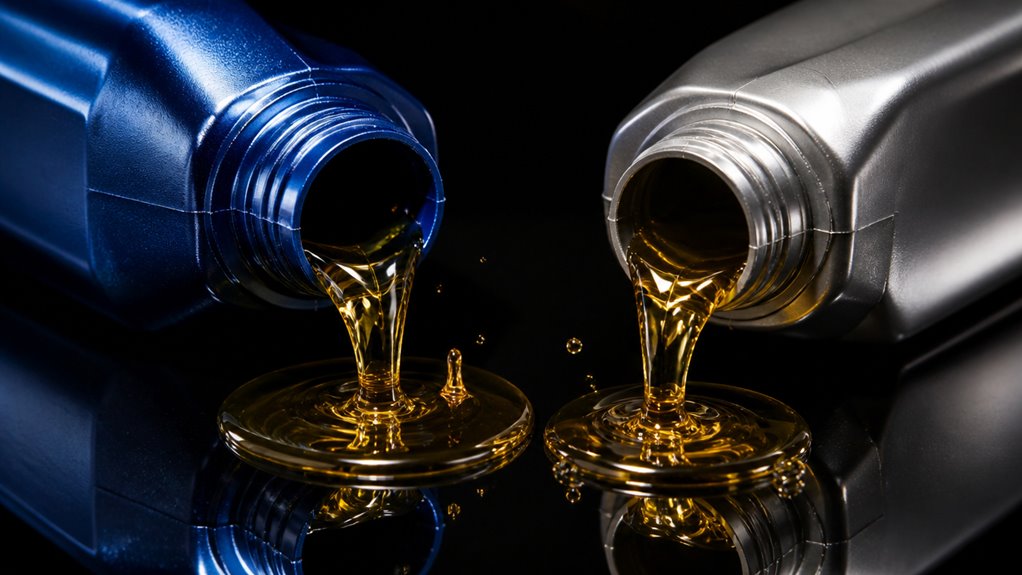
When choosing between AMSOIL and Royal Purple synthetic oils, focus on your priorities.
AMSOIL excels in extended drain intervals with superior cold-start fluidity and a higher Total Base Number (TBN) for acid neutralization.
Royal Purple offers stronger high-temperature shear resistance and a higher viscosity index for stability under heat.
If you want longer service intervals, AMSOIL leads; for peak performance in extreme conditions, Royal Purple shines.
Explore the detailed differences to pinpoint the best fit for your engine’s needs.


| Comparison Factors | AMSOIL Signature Series | Royal Purple HPS |
|---|---|---|
| Oil Type | Full synthetic motor oil | Synthetic high-performance motor oil |
| Primary Focus | Extended service intervals and engine protection | High-performance lubrication and friction reduction |
| Viscosity Index | 162 | 191 |
| HTHS Viscosity | 3.11 cP | 3.8 cP |
| Kinematic Viscosity at 100°C | 10.3 cSt | 11.09 cSt |
| Cold-Crank Viscosity at −30°C | 3,968 cP | 5,480 cP |
| Pour Point | −53°C | −44°C |
| Total Base Number (TBN) | 12.5 | 9.7 |
| Cold-Start Performance | Lower cold-crank viscosity in the article’s comparison | Higher cold-crank viscosity in the article’s comparison |
| High-Temperature Performance | Lower measured HTHS viscosity | Higher measured HTHS viscosity |
| Oil Film Characteristics | Emphasizes fluidity and wear protection | Emphasizes viscosity under heat and shear |
| Additive Focus | Acid neutralization and additive reserve | Friction reduction and high-temperature lubrication |
| Oil Service Interval | Article states up to 25,000 miles or one year | Article states 15,000 miles or one year |
| Fuel Efficiency Considerations | Lower viscosity may reduce pumping resistance | Higher viscosity may increase fluid resistance |
| Cold-Climate Suitability | Article favors frequent cold-weather starting | Article emphasizes high-temperature operation |
| Performance Driving | Designed for engine protection across demanding conditions | Article emphasizes high-load and high-heat lubrication |
| Overall Recommendation | Prioritize cold-flow characteristics and extended-drain capability | Prioritize the specified high-temperature viscosity characteristics |

When comparing AMSOIL and Royal Purple synthetic oils, you’ll want to focus on several key factors that directly impact engine performance and longevity.
AMSOIL positions its Signature Series as a premium, extended-drain oil, emphasizing protection and longer intervals.
AMSOIL’s Signature Series delivers premium, extended-drain protection designed for longer oil change intervals.
Royal Purple, with its HPS and High Performance lines, prioritizes friction reduction and performance feel.
Both target enthusiasts and daily drivers, but AMSOIL leans toward interval length and additive reserve.
It boasts a higher total base number (TBN) for acid neutralization.
Royal Purple highlights flow characteristics and stronger high-temperature film strength.
Your decision hinges on whether you prioritize extended drain capability and cold-start fluidity or enhanced high-temperature shear resistance and viscosity stability.
Additionally, AMSOIL meets stringent industry certifications that make it suitable for high-performance and European vehicles.
Understanding these brand positioning nuances guides you to a choice tailored to your engine’s demands.
Although both AMSOIL and Royal Purple produce high-quality synthetic oils, their viscosity and temperature performance differ in ways that can affect engine protection and efficiency.
When choosing between them, consider these key points:
It is important to note that Royal Purple has been criticized for its tendency to shear out of grade, which can affect long-term oil performance and protection.
How well your engine oil performs during cold starts can markedly impact engine wear and starting ease in low temperatures.
Engine oil performance during cold starts greatly affects engine wear and ease of starting in cold weather.
AMSOIL Signature Series 5W-30 offers a notably lower cold crank viscosity at -30°C (3,968 cP) compared to Royal Purple HPS (5,480 cP). This enables easier oil flow and reduced starter load.
Additionally, AMSOIL’s pour point of -53°C surpasses Royal Purple’s -44°C, indicating better fluidity in extreme cold conditions.
This lower viscosity and superior low-temperature operability mean AMSOIL can protect critical engine components more effectively during initial crank, reducing metal-to-metal contact.
Royal Purple’s higher viscosity index suggests stability across temperatures but doesn’t offset the higher cold crank resistance.
For cold climates or frequent low-temperature starts, AMSOIL’s formulation provides a measurable advantage in lubrication onset and engine protection during winter startups.
Moreover, Royal Purple’s emphasis on Synerlec Additive Technology enhances engine efficiency but may not improve cold-start fluidity as much as AMSOIL’s lower viscosity formulation.
Because engine oils must maintain protection under extreme heat and stress, understanding high-temperature protection and additive benefits is crucial for selecting the right formulation.
You’ll find that Royal Purple HPS offers a higher HTHS viscosity (3.8 cP vs. AMSOIL’s 3.11 cP), indicating stronger film strength under heat and shear.
Meanwhile, AMSOIL Signature Series delivers a higher total base number (12.5 vs. 9.7), signaling superior acid-neutralizing capacity and additive reserve.
Consider these points:
This technical balance guides your choice depending on your engine’s thermal and additive demands.
When deciding between AMSOIL and Royal Purple, you need to weigh the benefits of extended drain intervals against the demands of high-performance protection.
AMSOIL excels in longer service life with a 25,000-mile drain interval and a higher Total Base Number (TBN) of 12.5, indicating superior acid-neutralizing capacity.
Royal Purple focuses on enhanced high-temperature film strength, evidenced by its higher High-Temperature High-Shear (HTHS) viscosity of 3.8 cP, which supports better protection under extreme conditions.
Both oils utilize advanced additive technologies that significantly reduce wear and improve gear durability under stress, making extreme temperature performance a key consideration.
| Feature | AMSOIL Signature Series | Royal Purple HPS |
|---|---|---|
| Drain Interval | 25,000 miles / 1 year | 15,000 miles / 1 year |
| Total Base Number (TBN) | 12.5 | 9.7 |
| HTHS Viscosity (cP) | 3.11 | 3.8 |
Choose based on whether you prioritize extended intervals or high-temperature shear resistance.
Yes, you can technically mix AMSOIL and Royal Purple oils since both are synthetic and meet similar base standards.
However, doing so may compromise the optimized additive packages each brand designs for specific performance traits like cold-flow, viscosity, and longevity.
Mixing dilutes these engineered benefits and could reduce overall effectiveness.
For best results, stick to one brand to maintain consistent protection, additive balance, and performance characteristics tailored to your engine’s needs.
When it comes to warranty coverage, AMSOIL offers the stronger shield, akin to a knight’s steadfast armor.
You get a service-life guarantee of 25,000 miles, 700 hours, or one year, outpacing Royal Purple’s 15,000 miles or one year.
This extended coverage reflects AMSOIL’s confidence in additive reserve and protection.
You can push intervals longer without worry, making it the more robust choice for warranty security.
You’ll likely see marginal fuel economy gains with both oils due to their synthetic base and friction modifiers.
Royal Purple’s higher viscosity index and HTHS viscosity can enhance film strength but may slightly increase drag.
AMSOIL’s lower cold-crank viscosity and strong cold-flow properties reduce pumping losses, improving fuel efficiency, especially in cold starts.
Ultimately, AMSOIL’s formulation favors better fuel economy in colder conditions, while Royal Purple optimizes performance at operating temperatures.
Funny enough, when you swap oils, you often notice engine noise right away.
Both brands reduce noise due to synthetic base stocks and advanced additives.
Royal Purple’s higher HTHS viscosity suggests stronger film strength, potentially dampening mechanical noise under heat.
AMSOIL’s lower cold-crank viscosity helps smoother starts, which can also reduce initial noise spikes.
Ultimately, the difference is subtle; your choice hinges on whether you prioritize cold-start quietness or sustained high-temp noise control.
You’ll find both oils use synthetic bases that reduce waste by extending drain intervals, lowering disposal frequency.
AMSOIL’s longer service life means fewer oil changes, cutting environmental impact.
Royal Purple’s high-performance formula promotes efficiency, potentially reducing emissions.
However, neither brand specifically highlights biodegradability or recycled content.
When choosing between AMSOIL and Royal Purple, you’re looking at top-tier synthetic oils with distinct strengths.
AMSOIL excels in extended drain intervals, while Royal Purple offers robust high-temperature protection and superior additive packages.
Your decision boils down to whether you prioritize long-term maintenance or peak performance under stress.
In the end, consider your vehicle’s specific needs to get the best out of either oil.
Last update on 2026-10-31 / Affiliate links / Images from Amazon Product Advertising API