Physical Address
304 North Cardinal St.
Dorchester Center, MA 02124
Physical Address
304 North Cardinal St.
Dorchester Center, MA 02124
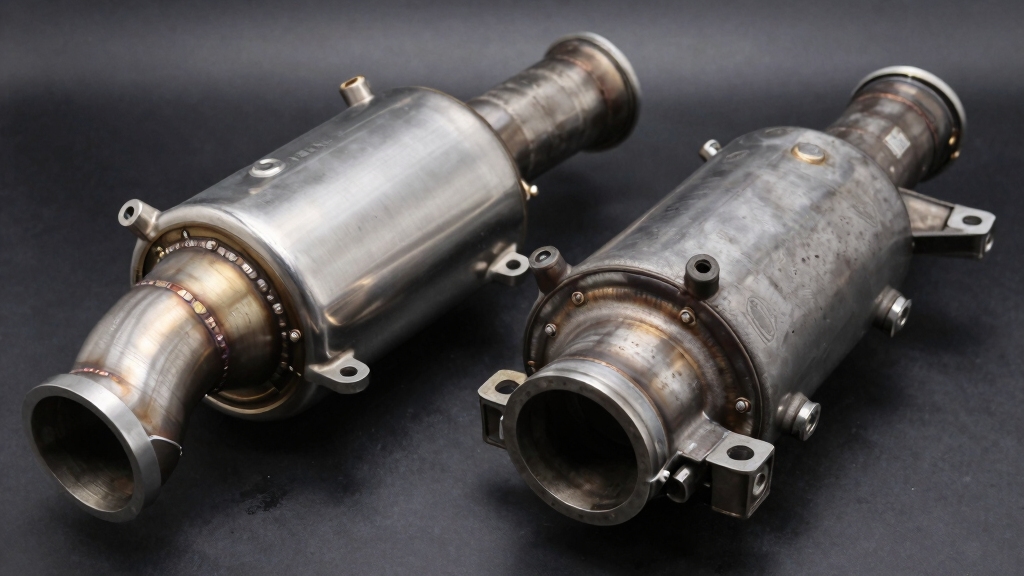
If you need a catalytic converter balancing cost, fit, and emissions, Magnaflow offers EPA-compliant units closely matching OEM designs through 3D precision scanning.
They use quality ceramic substrates with platinum, palladium, and rhodium, ensuring comparable performance and durability at a lower price.
However, Magnaflow lacks CARB certification, so it’s ideal outside strict states. OEM converters guarantee CARB compliance with higher precious metal loading and factory fitment.
Explore their differences further to make the best choice for your vehicle.
| Feature | Magnaflow Catalytic Converter | OEM Catalytic Converter |
|---|---|---|
| Emissions Compliance | EPA/Federal compliant (non-CARB states) | CARB-certified nationwide |
| Precious Metal Loading | Optimized platinum, palladium & rhodium | Higher loading for strict compliance |
| Fitment Options | Direct-fit (3D scanned) & universal | Exact factory specification |
| Installation | Plug-and-play (direct-fit models) | Guaranteed factory bolt-on fit |
| Warranty Coverage | 5-year / 50,000-mile warranty | 8-year / 80,000-mile (OEM standard) |
| Pricing | More cost-effective | Higher premium pricing |
| Performance & Sound | Comparable flow & tone | Factory-calibrated performance |
| Best For | Budget-conscious, non-CARB states | Strict emission states & factory spec |
When comparing Magnaflow catalytic converters to OEM units, you’ll find that both aim to meet stringent emissions standards while offering reliable fitment and durability.
Magnaflow converters utilize ceramic substrates coated with a washcoat containing platinum, palladium, and rhodium, matching or exceeding emission compliance for Federal/EPA standards outside restricted states.
OEM converters often incorporate higher precious metal loading, especially to meet CARB regulations.
While OEM units guarantee exact vehicle specifications, Magnaflow’s direct-fit models closely replicate OEM designs, ensuring comparable performance and longevity.
You’ll notice Magnaflow products come with robust 5-year/50,000-mile warranties, often exceeding OEM coverage.
Cost-wise, Magnaflow offers a balance between quality and affordability, priced lower than OEM but superior to cheaper aftermarket alternatives.
Both converters maintain efficient catalytic activity without compromising exhaust flow or sound characteristics.
Additionally, choosing a converter with advanced additive technology can enhance overall engine efficiency and performance.
When you go for a Magnaflow direct-fit catalytic converter, you’re really getting something special. These converters come with precise 3D-scanned dimensions that match your vehicle’s factory specifications perfectly. This means installation is a breeze!
On the flip side, if you opt for one of the universal Magnaflow models, be prepared for a bit more work. Those usually require professional fabrication, which can complicate things a bit.
Now, let’s talk about OEM converters for a moment. They’re designed to fit exactly without any need for modifications, so you can count on them for a straightforward installation. However, Magnaflow’s direct-fit options are pretty close to that standard.
They seamlessly integrate with aftermarket exhaust systems, giving you flexibility while maintaining that perfect fit. So, whether you want an easy install or a custom touch, there are solid options out there for you! Choosing the right component with precise fitment specifications ensures optimal performance and minimizes installation issues.
Although both Magnaflow and OEM catalytic converters aim for seamless integration, Magnaflow’s direct-fit models leverage advanced 3D scanning technology to guarantee precise replication of OEM dimensions. This allows you to replace parts without modification.
This precision assures Magnaflow’s HM grade converters match the exact geometry and mounting points of OEM units, facilitating seamless connection with your vehicle’s exhaust system. OEM converters naturally provide exact fitment, designed specifically for each vehicle model, eliminating fitment concerns.
Magnaflow’s direct-fit approach minimizes installation errors and the need for fabrication, contrasting with their universal models requiring professional adaptation. By matching OEM specifications meticulously,
Magnaflow direct-fit converters offer you a reliable, plug-and-play solution that maintains exhaust integrity and supports efficient emissions control without compromising structural or functional compatibility.
Similar to how Fel-Pro and Victor Reinz use OEM knowledge to enhance gasket fitment and sealing performance, Magnaflow’s precision ensures durability and reliability in real-world conditions.
Since installation ease greatly impacts the overall replacement process, understanding the fitment differences between Magnaflow and OEM catalytic converters is essential.
If you opt for Magnaflow’s direct-fit models, you’ll benefit from precise 3D-scanned designs that match OEM dimensions exactly. This allows straightforward bolt-on installation without modification.
This mirrors the OEM experience closely, ensuring seamless integration with your vehicle’s exhaust system. However, if you choose Magnaflow’s universal converters, expect a more complex installation requiring professional fabrication and welding.
OEM converters guarantee perfect fitment by factory standards, minimizing installation variables but often at a higher cost. Ultimately, if you prioritize ease and accuracy, Magnaflow direct-fit or OEM units simplify your job.
In contrast, universal aftermarket options demand advanced skills and additional time, increasing installation complexity. Proper component selection and installation are as critical in exhaust systems as using the correct transmission fluid viscosity is in maintaining transmission performance.

Because emissions standards vary by region and vehicle type, understanding the compliance differences between Magnaflow and OEM catalytic converters is essential.
Magnaflow offers multiple grades: EPA/Federal compliant models for OBDII vehicles outside California, Colorado, and New York; HM grade for select California applications outside restricted zones; and standard grade for pre-OBDII vehicles.
However, Magnaflow converters aren’t CARB-certified and aren’t sold in strict states like CA, CO, or NY.
In contrast, OEM converters meet CARB standards nationwide, incorporating higher precious metal loadings in their washcoat to guarantee stricter emissions compliance.
When you choose Magnaflow, you get EPA-compliant performance at a lower cost but limited regional legality.
OEM converters provide full emissions certification, critical if you live in states with rigorous environmental regulations or require CARB compliance for inspections.
When you’re diving into the comparison between Magnaflow and OEM catalytic converters, one thing that stands out is the precious metals they use. Both types have significant amounts of platinum, palladium, and rhodium, which are key to meeting emission standards. Pretty interesting, right?
Now, if we talk about OEM units, they usually pack in a bit more of these precious metals. This is mainly to comply with those stricter CARB regulations. That extra metal can really make a difference in terms of long-term performance and durability.
How do Magnaflow catalytic converters compare to OEM units in terms of precious metals content?
Both Magnaflow and OEM converters utilize platinum, palladium, and rhodium in their ceramic substrates coated with ceria washcoat.
OEM converters typically incorporate higher quantities of these precious metals to meet stringent CARB standards, ensuring compliance and inspection passing.
Magnaflow’s aftermarket units contain generous precious metal loadings sufficient to meet or exceed Federal/EPA emission requirements, though they generally carry slightly lower precious metal content than OEM counterparts.
This deliberate balance allows Magnaflow to maintain catalytic efficiency and durability at a more accessible price point.
When you evaluate precious metals content, Magnaflow offers a technically sound alternative to OEM with optimized metal distribution tailored for effective exhaust conversion without the premium metal loading mandated for CARB certification.
Choosing components with proper emission control ensures long-term engine performance and compliance with environmental standards.
Understanding the precious metals content helps clarify how Magnaflow and OEM catalytic converters meet emission standards. Both use platinum, palladium, and rhodium in their washcoat. However, OEM converters typically carry higher precious metals loading to comply with stringent CARB regulations.
Magnaflow focuses on Federal/EPA compliance, excluding some states with stricter rules.
Regular maintenance and timely replacement of emission components are essential to prevent issues such as persistent odors or leaks that may indicate mechanical problems affecting vehicle performance.
Although both Magnaflow and OEM catalytic converters utilize platinum, palladium, and rhodium in their washcoat, the difference in precious metal loading directly influences their performance and emissions efficiency.
OEM converters typically incorporate higher quantities of these precious metals to meet stringent CARB standards, ensuring optimized catalytic activity and lower emissions.
Magnaflow converters, while containing ample metal loading to meet or exceed Federal EPA requirements, generally have slightly lower precious metal content compared to OEM units.
This difference can marginally affect conversion efficiency under extreme conditions, but in typical usage, you’ll find Magnaflow delivers comparable performance.
Their ceramic substrates with ceria-enhanced washcoat maintain effective catalytic reactions, supporting consistent flow and durability.
Ultimately, the choice balances cost against precise emissions targets, with Magnaflow offering reliable performance near OEM levels at a reduced price point.
Additionally, selecting components that maintain thermal stability across a wide temperature range is critical to ensuring long-term catalytic converter function and durability.
When comparing pricing between Magnaflow and OEM catalytic converters, you’ll find that Magnaflow offers a more cost-effective solution without sacrificing quality.
You benefit from a balance of performance and affordability that OEM parts rarely match. Consider these points:
Choosing Magnaflow optimizes your investment by delivering quality and compliance at a lower cost than OEM units. Additionally, selecting converters that reduce oil burning emissions helps prevent engine overheating and prolongs engine life.
Even though OEM catalytic converters benefit from stringent CARB flow standards, Magnaflow’s designs closely mirror these specifications, ensuring comparable performance.
When you evaluate performance and sound, consider these points:
Additionally, choosing products with superior base oil composition can further enhance engine protection and longevity.
Thus, when you choose between Magnaflow and OEM, expect near-identical catalytic performance and sound characteristics. These are rooted in high-quality materials and design precision.
You’ll want to opt for Magnaflow catalytic converters when balancing cost efficiency with reliable, long-lasting performance matters most.
Magnaflow’s direct-fit models precisely match OEM specifications using 3D scans, ensuring seamless installation without modifications.
Their proprietary ceramic substrates coated with platinum, palladium, and rhodium provide emission compliance comparable to OEM converters, meeting Federal and EPA standards outside restricted states.
Additionally, Magnaflow offers a robust 5-year/50,000-mile warranty, doubling many aftermarket competitors and matching OEM durability claims.
While OEM converters contain more precious metals per CARB requirements, Magnaflow delivers superior value at a lower price point without sacrificing flow efficiency or sound quality.
Choose Magnaflow if you require a cost-effective, durable replacement with proven performance, especially when CARB certification isn’t mandated for your vehicle’s region.
While both Magnaflow and OEM catalytic converters serve the same fundamental purpose, several misconceptions persist about their fitment, performance, and compliance.
You might hear that Magnaflow units never fit perfectly, but direct-fit models use 3D scans ensuring exact OEM alignment.
Some claim Magnaflow converters don’t meet emissions standards; however, EPA-compliant grades cover most Federal applications.
Others believe OEM converters always outperform aftermarket, yet Magnaflow matches precious metal load and flow characteristics closely.
Finally, many think Magnaflow converters degrade faster, but their proprietary manufacturing yields durability with robust warranties.
When deciding between Magnaflow and OEM catalytic converters, you should evaluate factors such as fitment accuracy, emissions compliance, cost, and warranty coverage.
Magnaflow direct-fit models offer precise OEM-matched fitment using advanced 3D scanning, assuring straightforward installation.
Magnaflow direct-fit catalytic converters ensure precise OEM-matched fitment through advanced 3D scanning for easy installation.
OEM converters guarantee perfect factory specifications.
In emissions compliance, OEM converters meet strict CARB standards with higher precious metal loading.
Magnaflow covers Federal/EPA requirements but lacks CARB certification for California and select states.
Cost-wise, Magnaflow provides durable, high-quality converters at a lower price point than OEM.
It is backed by a robust 5-year/50,000-mile warranty, exceeding OEM’s limited coverage.
Ultimately, your choice hinges on regulatory needs, budget constraints, and installation preferences.
Magnaflow balances performance and value, while OEM ensures guaranteed compliance and fitment for regulated environments.
You generally can’t reuse your old catalytic converter when installing a Magnaflow unit.
Magnaflow direct-fit converters replace your OEM part to guarantee precise fit and emissions compliance.
Using your old converter alongside Magnaflow components risks fitment issues and emissions failures.
For peak performance and legal compliance, it’s best to fully replace the old converter with the new Magnaflow unit designed to match your vehicle’s specifications exactly.
Imagine driving through a hot desert where your catalytic converter faces intense heat.
You’ll find Magnaflow and OEM converters both withstand high temperatures, typically up to around 1,200°F (650°C).
Magnaflow’s proprietary ceramic substrates and precious metal coatings guarantee thermal stability, matching OEM standards designed for durability under extreme conditions.
You won’t find Magnaflow catalytic converters designed for pure electric vehicles, as EVs don’t generate exhaust gases requiring treatment.
For hybrids, compatibility depends on the specific model and emissions system.
Magnaflow’s direct-fit converters suit OBDII Federal/EPA compliant hybrids outside restricted states, but you must verify vehicle emissions standards and system design.
Always check with manufacturer specs to confirm if a Magnaflow converter matches your hybrid’s catalytic requirements for peak performance and compliance.
You might think disposing of Magnaflow and OEM catalytic converters impacts the environment differently, but both contain precious metals like platinum, palladium, and rhodium essential for emissions control.
Proper recycling recovers these metals, reducing mining needs and environmental harm.
Since Magnaflow converters use similar or slightly less precious metals than OEMs, recycling either is vital.
Your responsible disposal and recycling efforts directly minimize ecological damage regardless of the brand.
You won’t see a significant impact on your vehicle’s resale value with a Magnaflow catalytic converter installed.
Since Magnaflow offers direct-fit options matching OEM specifications, buyers recognize compliance with emissions standards and reliable performance.
Their durable design and solid warranty further reassure prospective buyers.
However, OEM converters might slightly enhance resale due to brand recognition and CARB certification, especially in states with strict emissions regulations.
When choosing between Magnaflow and OEM catalytic converters, remember that the devil is in the details. Magnaflow often offers better performance and sound with competitive pricing, while OEM guarantees precise fitment and emissions compliance.
Your decision hinges on priorities like installation ease, budget, and regulatory adherence. Analyze your vehicle’s needs carefully. Opting for Magnaflow can enhance power and tone, but OEM remains the safest bet for guaranteed factory standards and longevity.