Physical Address
304 North Cardinal St.
Dorchester Center, MA 02124
Physical Address
304 North Cardinal St.
Dorchester Center, MA 02124

You can mix regular gas with E85 safely if your vehicle is flex-fuel, as its ECU adjusts fuel delivery and timing for varying ethanol levels without damage.
In non-flex-fuel cars, mixing may trigger check engine lights, reduce fuel economy, or cause fuel system wear due to ethanol’s corrosive properties and lower energy content.
Blending ratios matter, and improper use may impair performance. Understanding your vehicle’s compatibility and fuel system materials helps guarantee proper operation.
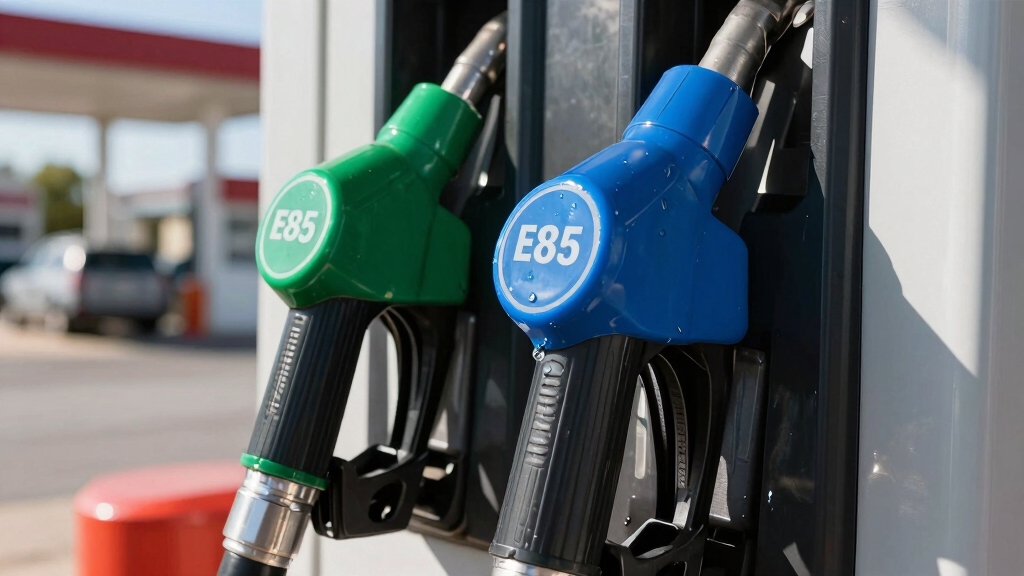
Although both fuels power internal combustion engines, E85 differs markedly from regular gasoline in its composition and properties. It contains up to 85 percent ethanol derived from fermented plant sugars, whereas regular gas typically includes only about 10 percent ethanol.
E85 fuel contains up to 85% ethanol, significantly more than the 10% in regular gasoline.
This high ethanol content markedly alters fuel characteristics, including lower energy density and higher octane rating, enhancing knock resistance. You’ll find ethanol sourced from corn, sugarcane, or cellulose waste, blended with 15 percent conventional gasoline.
This blend impacts combustion behavior and fuel system compatibility. Regular gasoline’s lower ethanol concentration minimally affects engine calibration, but E85 requires specific engine management adjustments to maintain optimal air-fuel ratios and performance.
Understanding these distinctions helps you assess fuel suitability and engine requirements, especially when considering blending or switching between fuels. Additionally, E85 generally delivers 20-30% fewer miles per gallon than regular gasoline due to its lower energy content.
Understanding the differences between E85 and regular gasoline sets the stage for evaluating their compatibility when mixed.
You can safely mix E85 with regular gas because ethanol and gasoline blend uniformly without separation. In flex-fuel vehicles (FFVs), this mix causes no issues; their systems detect ethanol content and adjust fuel delivery accordingly.
However, in non-FFVs, occasional mixing is tolerable but may trigger a check engine light due to oxygen sensor feedback. Keep in mind, E85 has lower energy density, so excessive amounts can reduce fuel economy and performance.
Also, ethanol’s corrosive nature demands compatible fuel system components to avoid damage. For peak safety and efficiency, consult your vehicle’s specifications and avoid consistently high ethanol blends if your car isn’t designed for them.
Proper fuel additives and filtration help maintain engine performance and prevent damage when using ethanol blends.

So, your flex-fuel vehicle is pretty smart! It can actually detect the ethanol concentration in the fuel using an onboard sensor. Isn’t that cool? This means it can dynamically adjust the fuel injection and ignition timing to make sure combustion is optimized.
What’s even better is that it can handle a wide range of fuel blends, from pure gasoline (that’s E0) all the way up to E85. It does this to ensure that the air-fuel ratios are just right and to prevent any engine knock.
Thanks to this adaptability, your vehicle maintains its performance and meets emissions standards no matter what blend of ethanol and gasoline you’re using. It’s quite an impressive feature, don’t you think?
Proper fuel quality, including additives that improve cold flow properties, also helps your engine start smoothly and run efficiently regardless of the blend, reducing wear and emissions during warm-up fuel quality.
When you fuel a flex-fuel vehicle (FFV), its onboard ethanol sensor immediately detects the ethanol concentration in the blend. This allows the engine control unit (ECU) to adjust fuel injection and ignition timing precisely.
This sensor uses infrared or capacitive technology to differentiate ethanol from gasoline molecules, enabling real-time monitoring. The ECU processes this data to optimize combustion, preventing knocking and maintaining efficiency across ethanol blends from E0 to E85.
| Ethanol % | Sensor Type | ECU Adjustment |
|---|---|---|
| 0-10% | Infrared | Minor timing/fuel tweaks |
| 11-50% | Capacitive | Moderate fuel increase |
| 51-85% | Infrared + Capacitive | Significant timing/fuel |
This detection mechanism guarantees engine performance and emissions remain within specifications regardless of fuel mix. Similar to diesel-kerosene blends, managing fuel composition precisely is essential to maintain optimal engine function and minimize emission reductions.
Because ethanol content varies widely between gasoline and E85, flex-fuel vehicles continuously adjust fuel delivery to maintain peak combustion. Your vehicle’s engine control unit (ECU) uses an ethanol sensor to measure blend ratio in real time, then modifies fuel injection timing and volume accordingly.
Higher ethanol percentages demand increased fuel volume due to ethanol’s lower energy density compared to gasoline. The ECU compensates by enriching the mixture to sustain optimal air-fuel ratios, preventing lean conditions that could cause knocking or misfires.
Simultaneously, it adjusts ignition timing to leverage ethanol’s higher octane rating, enhancing knock resistance. This dynamic calibration guarantees smooth engine performance and emissions control across various ethanol-gasoline blends up to E85, allowing you to switch fuels without manual tuning or performance loss.
Maintaining proper EVAP system function is important during these fuel changes because it prevents fuel vapor release and supports emissions compliance.
Although ethanol content varies widely between pure gasoline and E85, flex-fuel vehicles (FFVs) seamlessly accommodate blends across the entire spectrum from E0 to E85.
Your FFV detects ethanol concentration via onboard sensors and adjusts fuel injection timing, volume, and ignition parameters accordingly. This dynamic calibration guarantees peak combustion despite fluctuations in ethanol percentage.
The fuel system components, including stainless steel tanks, Teflon-lined hoses, and specialized injectors, resist ethanol’s corrosive effects, maintaining integrity throughout the blend range. You can mix any ethanol-gasoline ratio without separation or drivability issues, as the engine control unit (ECU) compensates in real-time.
Blends from E10 to E85 alter octane and energy content, but your vehicle’s adaptive controls maintain performance and emissions compliance. This broad compatibility underpins FFVs’ flexibility and efficiency when using mixed fuels.
Proper storage conditions and regular inspection of fuels ensure long-term fuel quality and optimal engine performance.
If you put E85 into a non-flex-fuel vehicle (non-FFV), you risk triggering the check engine light due to the oxygen sensor detecting higher ethanol levels than the engine control unit (ECU) expects.
The ECU, calibrated for lower ethanol content, interprets this as a lean condition and may adjust fuel delivery incorrectly. Since non-FFVs lack ethanol sensors and upgraded fuel system components, prolonged use of E85 can cause fuel system corrosion and fuel pump strain.
Additionally, E85’s lower energy density results in reduced fuel economy and potential drivability issues. However, a single accidental fill usually won’t cause mechanical damage.
Still, repeatedly running E85 in non-FFVs risks knocking and inefficient combustion, as these engines aren’t optimized for high ethanol blends, potentially affecting performance and long-term reliability.
Moreover, ethanol’s hygroscopic nature can lead to water absorption and fuel system damage when used improperly in non-FFVs.
Using E85 in a non-flex-fuel vehicle can trigger warning signals and impact performance. This raises the question of how to blend E85 with regular gasoline effectively.
A 50/50 E85-to-regular gas mix is widely recommended because it balances ethanol’s high octane benefits with gasoline’s higher energy content. This ratio typically yields an E50 blend, improving knock resistance and maintaining manageable fuel system compatibility.
Lower blends like E30 also enhance octane with fewer risks to non-upgraded components. However, exceeding E50 without flex-fuel modifications may cause fuel system corrosion and trigger engine management issues.
You should check your vehicle’s specifications before mixing, as most street car fuel pumps tolerate blends up to E50. Sticking to these ratios optimizes performance and minimizes risks in non-flex-fuel engines.
For maintaining engine health when using ethanol blends, using a fuel stabilizer designed to protect against ethanol-related corrosion and fuel degradation is highly recommended.
When you mix E85 with regular gas, you actually boost the overall octane rating. This is great because it improves the knock resistance of your engine. However, there’s a catch: it also lowers the fuel’s energy content per volume.
So, what does that mean for your car? Well, your engine’s tuning needs to adjust the fuel delivery to keep the right air-fuel ratio. This is really important because ethanol has a lower energy density.
If you don’t make those adjustments, you might run into some issues, like reduced power or even engine knocking. Getting a handle on these effects is key. It can help you optimize your car’s performance and avoid any potential problems.
So, if you’re thinking about mixing fuels, just keep these points in mind. Using appropriate additives can also support fuel system health and help maintain engine performance over time through fuel system stabilization.
Although ethanol has lower energy content than gasoline, mixing E85 with regular gas elevates the octane rating of the resulting blend. This enhances your engine’s resistance to knocking and pinging.
When you blend E85 with gasoline, the ethanol component raises the overall Anti-Knock Index (AKI). This improves combustion stability under higher compression.
For example, a 50/50 mix of 91-octane gas and E85 yields approximately a 96-octane blend. This allows your engine to operate more efficiently with reduced pre-ignition risk.
This higher octane rating enables more aggressive ignition timing and can potentially increase power output if your engine management system adjusts accordingly. However, precise octane gains depend on the blend ratio, as ethanol content directly correlates with knock resistance.
Mixing fuels thus offers a practical method to optimize octane without specialized high-octane gasoline. Additionally, using high-quality oils with advanced additives can help protect engines running on higher octane blends from increased wear and stress.
Since E85 contains markedly less energy per volume than regular gasoline, mixing the two fuels affects your engine’s performance by altering the available power output.
Ethanol’s lower energy density means that for the same volume, E85 delivers roughly 27% less energy than pure gasoline. When you blend E85 with regular gas, the resulting mixture reduces the overall energy content proportionally.
This reduction requires your engine to burn more fuel to maintain power, which can slightly lower fuel economy. However, the increased octane rating from ethanol helps prevent knocking and allows for more aggressive ignition timing if your engine management supports it.
Without tuning adjustments, your engine might experience a modest drop in torque and acceleration due to the diluted energy content. However, it will generally run smoothly with typical E50 blends.
Adjusting engine tuning becomes essential as you mix E85 with regular gasoline because the altered fuel composition impacts combustion characteristics.
Ethanol’s higher octane rating allows more advanced ignition timing and increased boost without knock, but its lower energy content requires richer fuel delivery. Your engine’s ECU must recalibrate air-fuel ratios and ignition timing to optimize power and efficiency.
| Parameter | Effect of E85-Gas Mix |
|---|---|
| Octane Rating | Increases, enabling higher timing |
| Air-Fuel Ratio | Richens, ethanol demands more fuel |
| Combustion Temp | Slightly cooler combustion |
| Knock Resistance | Improves, reduces pinging |
| Fuel Volume | Increases to compensate energy loss |
When using E85 blends, you need to focus on fuel system components designed to resist ethanol’s corrosive effects and accommodate its different chemical properties. Ethanol’s higher polarity and solvent nature can degrade standard materials, so only ethanol-compatible parts guarantee durability and safe operation.
Key components include:
Although mixing E85 with regular gasoline is generally safe in compatible vehicles, you should be aware of potential risks such as fuel system corrosion, engine knocking, and false check engine light triggers.
Mixing E85 with gasoline is typically safe in compatible vehicles but may cause corrosion, knocking, and false check engine lights.
Ethanol’s corrosive nature can degrade non-upgraded fuel lines and injectors, especially in non-FFVs lacking alcohol-resistant components. Excessive ethanol content may cause knocking due to altered combustion characteristics, particularly in engines not calibrated for high ethanol blends.
Additionally, higher oxygen levels in E85 can trigger oxygen sensor errors in gasoline-tuned ECUs, causing false check engine lights. While occasional mixing is unlikely to cause mechanical damage, consistently using high ethanol blends in incompatible systems accelerates wear and may impair performance.
To mitigate these risks, verify vehicle compatibility, limit ethanol concentration, and monitor engine diagnostics carefully when blending E85 with gasoline.
Coincidentally, mixing E85 with regular gas can influence your vehicle’s emissions test results. The higher ethanol content alters combustion, often reducing carbon monoxide and hydrocarbon emissions but increasing aldehydes and evaporative emissions.
If your car isn’t a flex-fuel vehicle, the altered oxygen sensor readings might trigger a check engine light, causing test failures. Always check your manufacturer’s guidelines to make certain your fuel blend complies with emissions standards and doesn’t compromise test outcomes.
Temperature markedly affects E85 and gasoline mixture stability. At higher temperatures, ethanol in E85 absorbs moisture from the air, causing phase separation where water and ethanol settle apart from gasoline.
This reduces fuel quality and can harm your engine. Cooler temperatures improve mixture homogeneity and reduce vapor pressure, minimizing evaporation losses.
You should store and use these blends within recommended temperature ranges to maintain fuel stability and guarantee consistent engine performance.
Like maintaining a delicate instrument, using E85 blends demands attention to your fuel system’s condition.
Over time, ethanol’s corrosive nature can wear down non-upgraded fuel lines, injectors, and seals, increasing maintenance costs.
If your vehicle isn’t flex-fuel compatible, expect more frequent replacements. However, with proper components, long-term expenses remain comparable to regular gasoline.
Monitoring and using recommended blends helps minimize wear and avoids costly repairs.
Yes, mixing E85 with regular gas affects fuel economy in cold weather. Ethanol’s lower energy density reduces mileage, and cold temperatures worsen this by causing incomplete vaporization.
However, blending E85 with gasoline improves cold start performance due to ethanol’s higher volatility. You’ll notice a slight drop in fuel economy, but mixing around E30 to E50 balances cold-weather drivability with efficiency better than pure E85.
Yes, mixing E85 with regular gas in marine or small engines can cause issues. These engines often lack corrosion-resistant fuel system components found in flex-fuel vehicles, so ethanol’s corrosive nature may degrade seals, lines, and injectors over time.
Additionally, higher ethanol blends can cause starting difficulties, vapor lock, and inaccurate air-fuel ratios, leading to poor performance or engine damage. Always check manufacturer guidelines before using ethanol blends in such engines.
When mixing E85 with regular gas, remember that haste makes waste. You can blend fuels cautiously, but only if your vehicle supports it. Preferably, use a flex-fuel model designed for ethanol variations. Using improper ratios or fueling non-flex-fuel cars risks engine damage and performance loss.
Prioritize compatible fuel system components and precise blending to maintain efficiency. Ultimately, informed choices and adherence to manufacturer guidelines will keep your engine running at peak performance without compromise.